Showing posts with label Saint Michael Archangel academia.edu Mother Teresa Michael H. Brown devil Pope Francis gender ideology Austrian bishop Andreas Laun. Show all posts

Sunday, December 13, 2015

Pope Francis was right about condoms and HIV

Embedded image permalink

By Mary Rezac
 
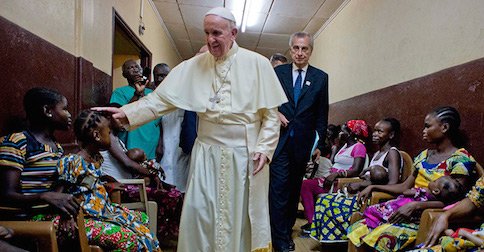
Vatican City, Dec 13, 2015 / 04:02 am (CNA/EWTN News).- On his return flight from Africa, as Pope Francis fielded the customary questions from the press, he challenged a journalist on a question about condom use in the fight to prevent HIV.
“We know that prevention is key. We know that condoms are not the only method of solving the epidemic, but it’s an important part of the answer,” the journalist said. “Is it not time for the Church to change its position on the matter? To allow the use of condoms to prevent more infections?”
The question, Pope Francis said, seemed too narrow to address such a widespread and complex issue. Condom use in and of itself could never solve the HIV crisis or other problems facing many African nations.
“The problem is bigger,” the Pope said.
“This question makes me think of one they once asked Jesus: ‘Tell me, teacher, is it lawful to heal on the Sabbath? Is it obligatory to heal?’ This question, ‘Is doing this lawful,’…but malnutrition, the development of the person, slave labor, the lack of drinking water, these are the problems.”
The Catholic Church has always held that artificial contraception use is immoral. In a 2010 book interview that made waves, Pope Benedict XVI said that while using a condom can represent a step in the right direction as far as showing concern for the other person, it is still an immoral solution to the HIV crisis.
But was Pope Francis right to be so dismissive of condom usage? Do condoms actually play a practical and important role in the fight against HIV?
An increasing amount of evidence says no.
 
Abstinence and fidelity in Uganda
 
At the peak of the HIV crisis in the 1980s, the country of Uganda had one of the highest infection rates – almost 25 percent of the population were HIV positive by 1991, according to the Washington Post.With the help of the country’s religious leaders, Uganda President Yoweri Museveni adopted the simplest and least expensive intervention possible in the poor and war-torn country – a public education program stressing abstinence before marriage and faithfulness afterward, largely de-emphasizing condom use except for those most at risk.
In just eight years, the country saw the most significant decline in HIV infection rates in the world.
According to a 2004 article in the “Journal of International Development”, it was “the lack of condom promotion during the 1980s and early 1990s (that) contributed to the relative success of behavior change strategies in Uganda.”
But just as Uganda was seeing a significant decline, the United States intervened, restructuring the country’s approach and focusing more on condoms and less on abstinence and monogamy. In an op-ed for the Washington Post, Harvard’s leading HIV researcher Dr. Edward Green and Wilfred Mlay, then-vice president for World Vision Africa, wrote that while the United States was generous in offering their help, the Western ideologies and approaches may have actually undermined the success previously seen in Uganda.
“The Ugandan turnaround was well underway by the time foreign AIDS experts began to arrive in the early 1990s, bringing with them the Western public health approaches—and values. They began to retool Uganda’s AIDS prevention efforts away from abstinence and fidelity—goals that many Westerners felt were unrealistic. As condom use increased, the percentage of young singles having sex rose from 27 percent to 37 percent between 1995 and 2000. Health officials worry that infection rates may increase as well,” they wrote.
The problem with condoms
Regardless of religious belief, condom use to curb HIV infection proves problematic for several reasons.
One of the biggest issues with the promotion of condoms as a solution to HIV is that most people do not consistently or correctly use condoms, even after going through sex education.
A study published by “The Annals of Pharmacotherapy” found that out of 500 couples who were repeatedly told by their doctors to use condoms, only eight percent did so consistently, despite knowledge that one partner had herpes. A different study found that only 50 percent of couples in which one partner had HIV used condoms consistently over time.
Another part of the problem is something called risk compensation. In an interview with the BBC, Dr. Green said that risk compensation happens when people use risk-reducing technology in a way that assumes the technology cancels out all risk.
As an example, in an interview with BBC, Dr. Green compared condom use to sunblock. He said the protection offered by sunblock is cancelled out when the person using sunblock assumes they are completely protected and therefore spends even more time in the sun.
Similarly, people using condoms are more likely to engage in risky sexual behavior because of the assumed protection, when in fact repeated exposure to infected persons decreases the protection that condoms offer.
The phenomenon of risk compensation also means people using condoms are more likely to have a greater number of sexual partners, increasing their risk for certain STDs which in turn increases the likelihood of the transmission of HIV. Many STDs create open sores, which act as portals of entry for HIV infection.
Another reason condoms alone fail at protecting people against HIV is because of the likelihood of disease transmission over time. According to a 2001 article in The Lancet, the more frequently one changes sexual partners, the more likely it is that they will spread HIV.
This is because HIV is highly contagious when it is first contracted, but it is often not detectable until later. Therefore, an infected person could think they are HIV-free and go on to infect more people before they realize they have HIV. The study found that if there were at least six months in between sexual partners, the rate of HIV infections would significantly decrease.
 
A tale of two countries: Philippines vs. Thailand
 
Two different countries in Asia help further illustrate the effectiveness of abstinence and fidelity programs over condom promotion.In 1984, both countries reported their first case of HIV infection. But the two governments had radically different responses.
Thailand’s response was to promote condom use across the board, while the largely Catholic country of the Philippines focused their response on promoting abstinence before marriage and fidelity afterwards.
By 2005, the HIV rate in Thailand was 50 times higher than that of the Philippines.
And while some experts hail Thailand as a success story rather than the Philippines, since Thailand’s rate of infection eventually decreased from previous levels, other experts say it is no coincidence that the Catholicism which permeates Filipino culture has led to a small rate of HIV infection.
 
Catholicism and HIV infection rates
 
Although some experts are hesitant to recognize the effectiveness of abstinence and fidelity programs promoted by the Catholic Church, a 2005 article in British Medical Journal hailed their success.
“The greater the percentage of Catholics in any country, the lower the level of HIV. If the Catholic Church is promoting a message about HIV in those countries, it seems to be working,” the article states.
“On the basis of data from the World Health Organization, in Swaziland, where 42.6 percent have HIV, only 5 percent of the population is Catholic. In Botswana, where 37 percent of the adult population is HIV infected, only 4 percent of the population is Catholic. In South Africa, 22 percent of the population is HIV infected, and only 6 percent is Catholic. In Uganda, with 43 percent of the population Catholic, the proportion of HIV infected adults is 4 percent.”
Dr. Green, too, emphasized in a 2009 article that his support of abstinence and fidelity programs comes not from a conservative worldview but rather from his experiences in Africa and from looking at the results.
“I’m a flaming liberal, don’t go to church, never voted for a Republican in my life,” he said.
In his aforementioned op-ed, he also added that it would be a wrong to place politics and ideologies above the lives of people who are at risk.
“Billions of dollars and the lives of countless men, women, and children will be wasted if ideology trumps proven health policy.”
….
Taken from: http://www.catholicnewsagency.com/news/the-pope-was-right-about-condoms-and-hiv-49253/

Tags: Contraception, HIV/AIDS, Pope Francis
 

Read next »

How Pope Francis is fulfilling a legacy of Vatican II

Sunday, August 9, 2015

'With war one always loses:' Pope Francis calls for nuclear weapons ban


Image result for nuclear war
   
Pope Francis © Tony Gentile
“Seventy years ago, on the sixth and the ninth of August 1945, the terrible atomic bomb attacks on Hiroshima and Nagasaki took place. Even after so many years, this tragic event still arouses horror and revulsion,” he told the faithful in his weekly Angelus address at St. Peter’s Square.


The pope said that the attacks are a symbol of the “enormous power of humanity” when people misuse scientific and technical progress.


[This event] serves as a lasting warning to humanity so that it rejects forever war and bans nuclear weapons and all arms of mass destruction,” the pope said.


“May one cry rise up from every land, ‘No’ to war and violence and ‘Yes’ to dialogue and to peace. With war one always loses. The only way to win a war is never to wage it,” was his conclusion.


....


Taken from: https://www.rt.com/news/312005-pope-francis-hiroshima-war/

Tuesday, June 30, 2015

They talk of searching for the habits and habitat of the Missing Link; as if one were to talk of being on friendly terms with the gap in a narrative or the hole in an argument.

Image result for java man


Introduction to the Book of Job


....


For instance, I have pointed out the difficulty of keeping a monkey and
watching it evolve into a man. Experimental evidence of such an
evolution being impossible, the professor is not content to say (as most
of us would be ready to say) that such an evolution is likely enough
anyhow. He produces his little bone, or little collection of bones, and
deduces the most marvellous things from it. He found in Java a piece of
a skull, seeming by its contour to be smaller than the human. Somewhere
near it he found an upright thigh-bone and in the same scattered fashion
some teeth that were not human. If they all form part of one creature,
which is doubtful, our conception of the creature would be almost
equally doubtful. But the effect on popular science was to produce a
complete and even complex figure, finished down to the last details of
hair and habits. He was given a name as if he were an ordinary
historical character. People talked of Pithecanthropus as of Pitt or Fox
or Napoleon. Popular histories published portraits of him like the
portraits of Charles the First and George the Fourth. A detailed drawing
was reproduced, carefully shaded, to show that the very hairs of his
head were all numbered No uninformed person looking at its carefully
lined face and wistful eyes would imagine for a moment that this was the
portrait of a thigh-bone; or of a few teeth and a fragment of a cranium.
In the same way people talked about him as if he were an individual
whose influence and character were familiar to us all. I have just read
a story in a magazine about Java, and how modern white inhabitants of
that island are prevailed on to misbehave themselves by the personal
influence of poor old Pithecanthropus. That the modern inhabitants of
Java misbehave themselves I can very readily believe; but I do not
imagine that they need any encouragement from the discovery of a few
highly doubtful bones. Anyhow, those bones are far too few and
fragmentary and dubious to fill up the whole of the vast void that does
in reason and in reality lie between man and his bestial ancestors, if
they were his ancestors. On the assumption of that evolutionary
connection (a connection which I am not in the least concerned to deny),
the really arresting and remarkable fact is the comparative absence of
any such remains recording that connection at that point. The sincerity
of Darwin really admitted this; and that is how we came to use such a
term as the Missing Link. But the dogmatism of Darwinians has been too
strong for the agnosticism of Darwin; and men have insensibly fallen
into turning this entirely negative term into a positive image. They
talk of searching for the habits and habitat of the Missing Link; as if
one were to talk of being on friendly terms with the gap in a narrative
or the hole in an argument, of taking a walk with a non-sequitur or
dining with an undistributed middle.


....
 

Wednesday, June 24, 2015

The pope's climate change message is really about rethinking what it means to be human.


Image result for pope climate change encyclical

by Stephen P. White on June 24, 2015


Given the media coverage since its release, and the political implications of the pope throwing his moral weight behind one side in a high-stakes debate about climate policy, one could be forgiven for thinking that Pope Francis's new encyclical is mostly about climate change and what we need to do to combat it.
Except it is and it isn't. In fact, mostly it isn't.


Pope Francis is urging the world to act on climate change. Here are his key points.
10 tips for a happy life, according to Pope Francis


What makes this encyclical controversial is its reading of contested questions of science, economics, and politics. What makes it radical — in the sense of going to the root — is the pope's reading of the profound human crisis that he sees underlying our modern world. Abuse of our environment isn't the only problem facing humanity. In fact, Pope Francis sees the ecological crisis as a symptom of a deeper crisis — a human crisis. These two problems are related and interdependent. And the solution is not simply to eliminate fossil fuels or rethink carbon credits. The pope is calling on the world to rediscover what it means to be human — and as a result, to reject the cult of economic growth and material accumulation.
Reading the encyclical, one quickly realizes that the "pope fights climate change" narrative is far from the whole story. In fact, that line leaves out the most fundamental themes of the encyclical: the limits of technology and the need for what he calls an "integral ecology," which "transcend[s] the language of mathematics and biology, and take[s] us to the heart of what it is to be human."

The science

Most of what Pope Francis has to say about climate change — and pollution, loss of biodiversity, lack of access to water, etc. — is in the first chapter. This section has garnered the most headlines — along with a later chapter, which looks at practical solutions — because it touches most directly on contested questions of science and policy.
The pope's assessment of the current environmental crisis is grim: "The earth, our home, is beginning to look more and more like an immense pile of filth." On climate change, he writes, "A very solid scientific consensus indicates that we are presently witnessing a disturbing warming of the climatic system." He goes on to warn: "If present trends continue, this century may well witness extraordinary climate change and an unprecedented destruction of ecosystems, with serious consequences for all of us."
Pope Francis sees the ecological crisis as a symptom of a deeper crisis — a human crisis
As for who is responsible for all this, he places the burden at the feet of the developed world: "Many of those who possess more resources and economic or political power seem mostly to be concerned with masking the problems or concealing their symptoms, simply making efforts to reduce some of the negative impacts of climate change."
Francis warns especially of the damage that our "culture of waste" does to the poor. He dismisses attempts at population control while leveling broadsides against financial markets, inequality, and the indifference of the rich. Moreover, he sees all these disturbing trends as interconnected. A casual attitude toward material goods leads to a casual attitude toward people. A willingness to exploit creation is deeply connected to a willingness to exploit human beings.

The limits of technology

While much has been said about the pope's embrace of the scientific evidence of climate change and the dangers it poses, the irony is that he addresses this crisis in a way that calls into question some of the oldest and most basic assumptions of the scientific paradigm.
Francis Bacon and René Descartes — two fathers of modern science in particular — would have shuddered at this encyclical. Bacon was a man of many talents — jurist, philosopher, essayist, lord chancellor of England — but he's mostly remembered today as the father of the scientific method. He is also remembered for suggesting that nature ought to be "bound into service, hounded in her wanderings and put on the rack and tortured for her secrets." Descartes, for his part, hoped that the new science he and men like Bacon were developing would make us, in his words, "masters and possessors of nature."
At the very outset of the encyclical, before any mention of climate change or global warming, Pope Francis issues a challenge to the Baconian and Cartesian view, which sees the world as so much raw material to be used as we please. Neither Descartes nor Bacon is mentioned by name, but the reference is unmistakable. Pope Francis insists that humanity's "irresponsible use and abuse" of creation has come about because we "have come to see ourselves as [the Earth's] lords and masters, entitled to plunder her at will."
Global warming, explained

Global warming, explained

Launch Card Stack!


Put another way, Pope Francis insists that the material world isn't just mere stuff to be dissected, studied, manipulated, and then packaged off to be sold into service of human wants and needs. The pope repeatedly warns against the presumption that technological advances, in themselves, constitute real human progress. In a typical passage, he writes, "There is a growing awareness that scientific and technological progress cannot be equated with the progress of humanity and history, a growing sense that the way to a better future lies elsewhere." The pope writes critically of "irrational confidence in progress and human abilities." He writes hopefully of a time when "we can finally leave behind the modern myth of unlimited material progress."
This isn't to say that Pope Francis is anti-technology or even, as some have suggested, anti-modern, but he is deeply critical of both our technological mindset and modernity's utilitarian propensities. While he acknowledges with gratitude the benefits humanity has derived from modern technology, which has "remedied countless evils which used to harm and limit human beings," he also calls into question — forcefully — the idea that utility is the proper measure of our interaction with creation.

An integral, human ecology

The utilitarian mindset that treats creation as so much "raw material to be hammered into useful shape" inevitably leads us to see human beings through the same distorted lens. Pope Francis is unsparing in his criticism of the disregard for human life, insisting, as his predecessors did, that any authentic ecology must be built on what Pope John Paul II called "human ecology." Pope Francis states directly:


[C]oncern for the protection of nature is also incompatible with the justification of abortion. How can we genuinely teach the importance of concern for other vulnerable beings, however troublesome or inconvenient they may be, if we fail to protect a human embryo, even when its presence is uncomfortable and creates difficulties?

It's not just abortion that is incompatible with an authentic ecology. "There can be no ecology," Pope Francis writes, "without an adequate anthropology." That means we have to recognize the limits to our own freedom, even with regard to ourselves. "[T]hinking that we enjoy absolute power over our own bodies turns, often subtly, into thinking that we enjoy absolute power over creation." Francis goes on to warn against unhealthy attempts to "cancel out sexual differences."
"Everything is connected" is a constant refrain in this encyclical, and it serves to underscore the way Pope Francis understands the vocation — the calling — of the whole human race. We were made by God and for God. His gift of creation is also part of that vocation and comes with responsibility for its care and development. We're part of creation, but also is custodians. Creation's greatest beauty is in its ability to reflect the glory of its maker.
Christians believe in a God who entered into his own creation in order to redeem it Most religions understand that reality is not limited to physical existence; there are also spiritual realities. But Christians, and Catholics in particular, have always insisted that while the spiritual and physical are distinct, they aren't so easily separated. Even material reality is more than just material.
Many Christians, and certainly Catholics, take a sacramental view of reality: a view in which mere things are never just mere things. All that exists is shot through with meaning, since it bears the fingerprints of the one who made it. Pope Francis quotes Scripture to this effect: "Through the greatness and the beauty of creatures one comes to know by analogy their maker" (Wisdom 13:5).
Moreover, Christians believe in a God who took on human flesh — entered into his own creation — in order to redeem it. "For Christians," Pope Francis writes, "all the creatures of the material universe find their true meaning in the incarnate Word, for the Son of God has incorporated in his person part of the material world, planting in it a seed of definitive transformation."
This sacramental view of the world changes the way Catholics estimate the worth and value of things, which have their own intrinsic worth and meaning apart from any utility they might hold for us. Because creation is the gift of a loving God, entrusted to us all for its care and maintenance, we are not free to simply do with it as we please. For Pope Francis, the world is most definitely not what we make of it; it's much more.

The critics

Critics will (and do) argue that the pope does little to grapple with the tension between the economic growth and development that has allowed billions to escape dire poverty — development fueled, literally, by the same polluting technologies Francis sharply criticizes and would see curtailed — and the pope's call for all to share in the very benefits that such growth and development has made possible. For all its problems, the fact that the global economy has lifted billions out of the worst poverty must count for something. Would the pope have us hamstring the engine of economic development for the sake of environmental conservation? And if so, how are the poor to receive the incredible benefits that our modern economy has made possible?
The pope's answer, it seems, is that the material benefits of our modern economy might not be quite so wondrous as we like to think. In a poorer world, a world less able to afford self-reliance, solidarity between people will be all the more important. As he writes toward the end of the encyclical:

Christian spirituality proposes an alternative understanding of the quality of life, and encourages a prophetic and contemplative lifestyle, one capable of deep enjoyment free of the obsession with consumption. We need to take up an ancient lesson, found in different religious traditions and also in the Bible. It is the conviction that "less is more."

This may be rather shocking to some, perhaps even most. So let me suggest a way to understand how the "pope of the poor" can, essentially, advocate for a poorer world. Francis is a man who understands that abject poverty grinds men down and crushes their human dignity. It is inhumane and unjust, a source of scandal and a cause for moral outrage. But the pope is also a man who understands that there is a kind of relative poverty in which basic material needs are met but there is limited room for luxury and no room for waste.
This kind of poverty can provide detachment from material things, allowing us to enjoy them for what they are — gifts from a generous and loving God. This understanding of poverty — which has deep Christian roots going back to the Gospel itself — is far from an unqualified evil. In fact, it's a virtue. And for Pope Francis — a man who long ago took his own vow of poverty, and took as his namesake a man of profound poverty, Francis of Assisi — this understanding provides a crucial insight into the way human beings relate to the world around us and to one another.

Like I said, the pope's views on climate change aren't what make this a radical document.


Stephen P. White is a fellow in the Catholic studies program at the Ethics and Public Policy Center in Washington, DC.


....


Taken from: http://www.vox.com/2015/6/24/8834413/pope-climate-change-encyclical


Tuesday, June 23, 2015

“Doomsday predictions can no longer be met with irony or disdain,” the pope writes.


Image result for doomsday predictions


You might call it his first miracle. Pope Francis has succeeded in getting the New York Times NYT 0.28 % to do what perhaps no pope has done before: hail a papal teaching as “authoritative.”
For decades the Times has warred with popes over moral issues such as marriage or the value of unborn life. But when it comes to science and climate change, the paper that likes to regard itself as the paper of record is now on record as recognizing the authority of a papal encyclical.
True, the Times did modify its praise with the adverb “unexpectedly.” And in fairness, it was Pope Francis who crossed the Tiber to embrace the Times’s orthodoxy here rather than the other way around. But such is the glee at having a papal imprimatur on the notion of man-made climate change leading the planet to catastrophe, those busy applauding are willing to overlook the pope’s critique of an environmentalism that protects endangered species but not the unborn child.
Then again, perhaps that’s because they recognize he has embraced their logic if not their conclusion. For if resources are truly finite, and if man is driving climate change, then each additional human being means a smaller slice of the pie for everyone else—and a larger carbon contribution that brings us closer to environmental Armageddon. The point is, it’s not the logic the greens have wrong; it’s their assumptions.
Which brings up a striking characteristic of this document: its bleakness. Only months ago, Pope Francis warned members of the Vatican Curia against being too dour. His earlier apostolic exhortation was called “The Gospel of Joy.” But for a document whose title is taken from a St. Francis of Assisi hymn celebrating God’s creation, “Laudato Si’ ” (“Be praised”) is steeped in pessimism. “Doomsday predictions can no longer be met with irony or disdain,” the pope writes.
Other popes have issued bracing critiques of modern Western culture. Pope Francis, however, goes deeper. This encyclical is less a corrective to the excesses of science and technology and markets than it is an argument that they are fatally flawed.
In an online article for the religious journal First Things, editor R.R. Reno describes the encyclical as a “dark reflection on the systemic evils of modernity,” one that sees “perversion and decadence in a global system dominated by those who consume and destroy.” Pope Francis at one point declares business “a noble profession,” but you’d never know it from the rest of the document.
Indeed, the pope seems to embrace the idea that global capitalism exploits those in poor countries—even though investing in a factory or opening a business in the developing world is inherently an affirmation. It means a company recognizes that a place and its people have untapped potential: They have something to contribute to the global economy. The pope often denounces the “economy of exclusion,” and rightly so. But economic growth and the expansion of markets are inclusive.
As for the environment, yes, there are plenty of examples when businesses befoul the environment and leave the costs to the community. But if profit is the problem, why is it that the cleanest water, the healthiest air and the greenest environments are in rich and developed lands rather than poor and undeveloped ones?
In some ways the conflict is not new. After all, it was a cleric, the Rev. Thomas Malthus, who gave his name to a zero-sum view of life that saw men and women breeding to their own destruction. In sharp contrast, the first economist, Adam Smith, wrote that to complain about population growth was to lament “over the necessary effect and cause of the greatest public prosperity.”
Nor is Smith alone. Gary Becker won the 1992 Nobel Prize in economics for his work on human capital. Julian Simon called people “the ultimate resource” in his 1981 book by that title. In the 1970s when predictions of a global apocalypse were also in vogue, Lord Peter Bauer of the London School of Economics countered Malthusian materialistic assumptions by highlighting the absurdity of the idea that when a calf is born the national wealth goes up, but when a baby is born it drops.
Put it this way. If you were a parent whose family was languishing in soul-crushing poverty in some desperate part of Africa, you’d hear two messages today:
The economist and entrepreneur will tell you that there is no nation so poor that its people cannot lift up themselves if they have the freedom to take advantage of modern technology and participate in the global marketplace. In the process, their neighbors will also be enriched and the environment improved.
Meanwhile, Pope Francis suggests that the impoverished in the developing world can never have better lives or a cleaner environment until the West imposes a much-reduced standard of living on itself.
Which offers the more hopeful and human way forward?


....


Taken from: http://www.wsj.com/articles/SB10181154852263044738504581063911625647734

Friday, June 19, 2015

Pope Francis calls for action 'here and now' to tackle climate change and halt 'unprecedented destruction' of ecosystems


Image result for pope climate change encyclical


The Pope has issued a call for the world to act quickly to prevent climate change from destroying the planet, saying the Earth is starting to resemble "an immense pile of filth".


In the first papal document, or encyclical, dedicated to the environment, Pope Francis demanded swift action on Thursday to head off what he sees as looming environmental ruin, and urged world leaders to hear "the cry of the Earth and the cry of the poor."
He called for "decisive action, here and now", to stop environmental degradation and global warming, squarely backing scientists who say it is mostly man-made.
Arguing environmental damage was intimately linked to global inequality, he said doomsday predictions could no longer be dismissed and "the Earth, our home, is beginning to look more and more like an immense pile of filth".
In the encyclical, titled Laudato Si (Praise Be), On the Care of Our Common Home, Francis advocated a change of lifestyle in rich countries steeped in a "throwaway" consumer culture and an end to an "obstructionist attitudes" that sometimes put profit before the common good.
He also took on big business, appearing to back "what consumer movements accomplish by boycotting certain products" in order to force companies to respect the environment.

Developing countries need help from polluting nations: Pope

The encyclical left no doubt that the ponitff believed the world was on a fast-track to disaster after decades of inaction.
"If present trends continue, this century may well witness extraordinary climate change and an unprecedented destruction of ecosystems, with serious consequences for all of us," he wrote.
Bemoaning the "remarkable" weakness of political responses to this, Pope Francis accused sceptics of cynically ignoring or manipulating the scientific evidence.
"There are too many special interests, and economic interests easily end up trumping the common good and manipulating information so that their own plans will not be affected," he wrote.
"We know how unsustainable is the behaviour of those who constantly consume and destroy, while others are not yet able to live in a way worthy of their human dignity," he added, saying the time had come for parts of the world to accept decreased growth.

Environment news in your inbox

Subscribe to get ABC News delivered to your email, including top environment coverage, plus the day's main news and analysis and alerts on major breaking stories.
The Pope said fossil fuel-based technology needed to be "progressively replaced without delay".
Developing countries would need financial help to do this from "countries which have experienced great growth at the cost of the ongoing pollution of the planet" and this pact had to be enshrined in binding accords.

Calls backed by Melbourne archbishop

Melbourne Archbishop Denis Hart backed the Pope's calls.
"I think the Pope has put it front and centre that climate change and the needs of our world have to be part of the program of all Catholics," he told Lateline.
"He's saying that we've got a serious obligation to be responsible for our brothers and sister, to be responsible for the world, and if we do nothing about that, then we are doing wrong."
Archbishop Hart said he did not believe Pope Francis had crossed a line into politics.
"I think the message will gradually spread that we can't just go ahead with the culture of waste, with allowing ourselves just to consume ... and think of ourselves and not think of anyone else," he said.
"And so from our pulpits these matters have to be put to people ... that we are brothers and sisters, we have to care for our common home – the world."
But Gerard Henderson, executive director of the Sydney Institute, said the Pope's call put the church in a "fashionable position".
"If you are going to decrease the living standards of people who are trying to get out of poverty in China and India, I don't think this is a very smart way to do it," he said.
Dr Paul Collins, a former Catholic priest and author, agreed the Pope was sending a clear message on the world's obligation to tackle climate change.
"What the Pope is trying to get at here is that sin is not just about what individuals do. Sin is also about what communities and institutions do," he said.

Greens groups hail pontiff's calls; sceptics dismiss document

Green activists hailed the pontiff's widely-trailed intervention as a potential game-changer in the debate over what causes global warming and how to reverse it.
"Everyone, whether religious or secular, can and must respond to this clarion call for bold urgent action," Kumi Naido, the international executive director of Greenpeace, said.
"Climate change is no longer just a scientific issue; it is increasingly a moral and ethical one," Yolanda Kakabadse, president of WWF, said.
"It affects the lives, livelihoods and rights of everyone, especially the poor, marginalised and most vulnerable communities."
Christiana Figueres, head of the Bonn-based UN Climate Change Secretariat, said the encyclical provided a powerful impetus to governments to agree on a strong pact when they meet in Paris in November.
"This clarion call should guide the world towards a strong and durable universal climate agreement in Paris at the end of this year," she said in a statement.
Mark Maslin, professor of climatology at University College London, said the Vatican had moved the issue forward.
"When theological, political and scientific leaders all call for rapid decarbonisation of our global economy it must be time we finally listen and create a binding international climate change agreement," he said.
But even before the encyclical's official publication, climate change sceptics dismissed the document's argument that the phenomenon is primarily man-made and that humanity can reverse it through lifestyle changes including the phasing-out of fossil fuels.
"I don't get economic policy from my bishops or my cardinal or my Pope," United States presidential candidate Jeb Bush said on the eve of the release in comments that underlined the depth of opposition in the country to a binding agreement to curb greenhouse gases.
The encyclical referenced the arguments of the sceptics by acknowledging that volcanic activity, variation in the Earth's movements and the solar cycle are factors in climate change.
But it maintained that "most global warming in recent decades is due to the great concentration of greenhouse gases released mainly as a result of human activity".
ABC/wires

Sunday, June 14, 2015

Pope Francis to Explore Climate’s Effect on World’s Poor

VATICAN CITY — Ban Ki-moon arrived at the Vatican with his own college of cardinals. Mr. Ban, the United Nations secretary general, had brought the leaders of all his major agencies to see Pope Francis, a show of organizational muscle and respect for a meeting between two global institutions that had sometimes shared a bumpy past but now had a mutual interest.
The agenda was poverty, and Francis inveighed against the “economy of exclusion” as he addressed Mr. Ban’s delegation at the Apostolic Palace. But in an informal meeting with Mr. Ban and his advisers, Francis shifted the discussion to the environment and how environmental degradation weighed heaviest on the poor.
“This is the pope of the poor,” said Robert Orr, who attended the May 2014 meeting as Mr. Ban’s special adviser on climate change and described the informal conversation with Francis. “The fact that he is making the link to the planet is really significant.”
Continue reading the main story

On Thursday, Francis will release his first major teaching letter, known as an encyclical, on the theme of the environment and the poor. Given the pope’s widespread popularity, and his penchant for speaking out on major global issues, the encyclical is being treated as a milestone that could place the Roman Catholic Church at the forefront of a new coalition of religion and science.
 
Francis, the first pope from the developing world, clearly wants the document to have an impact: Its release comes during a year with three major international policy meetings, most notably a United Nations climate change conference in Paris in December. This month, the Vatican sent notifications to bishops around the world with instructions for spreading the pope’s environmental message to the more than one billion Catholics worldwide.
By wading into the environment debate, Francis is seeking to redefine a secular topic, one usually framed by scientific data, using theology and faith. And based on Francis’ prior comments, and those of influential cardinals, the encyclical is also likely to include an economic critique of how global capitalism, while helping lift millions out of poverty, has also exploited nature and created vast inequities.
Vatican officials say that the encyclical is a theological document, not a political one, and have refused to divulge the contents. But there is already much speculation about how Francis will comment on humans’ role in causing climate change, a link he has spoken about in the past. The Vatican’s scientific academy recently attributed climate change to “unsustainable consumption” and called it “a dominant moral and ethical issue for society.”
This stance has rankled some conservative Catholics, as well as climate change skeptics, who have suggested that Francis is being misled by scientists and that he could veer into contentious subjects like population control. Others have argued that papal infallibility does not apply to matters of science. In April, a group of self-described climate skeptics, led by the Heartland Institute, a libertarian group, came to Rome to protest.
Bishop Marcelo Sánchez Sorondo of Argentina, who is also chancellor of the Vatican’s Pontifical Academy of Sciences, has sharply rebutted the criticism and postulated that many of the attacks have been underwritten by oil companies or influenced by conservative American interests, including the Tea Party. “This is a ridiculous thing, completely,” Bishop Sorondo said in an interview at the Vatican.

The first clue of the pope’s interest in the environment came when he chose his name in honor of St. Francis of Assisi, the 13th century friar who dedicated himself to the poor and is considered the patron saint of animals and the environment. Francis had shown interest from his days in Argentina, when he was Cardinal Jorge Mario Bergoglio, the archbishop of Buenos Aires.
There, he played a major role in convening different leaders to seek solutions for Argentina’s social ills. Francesca Ambrogetti, who co-wrote a biography of Francis, said he pushed for scientists at the Pontifical Catholic University of Argentina to investigate the impact of environmental issues on humanity. As far back as September 2004, Cardinal Bergoglio cited the “destruction of the environment” as contributing to inequality and the need for social reforms. At a 2007 meeting of Latin American bishops in Aparecida, Brazil, he oversaw the drafting of a broad mission statement that included an emphasis on the environment.
Pablo Canziani, an atmospheric physicist who researches climate change, said Francis, who had once trained as a chemist, became very interested in the links between environmental destruction and social ills, including a dispute over paper pulp mills on the border with Uruguay, which Argentina claimed were polluting local drinking water.
The pope, Professor Canziani added, has stayed in touch. Last year, the Vatican invited professors at his university to contribute ideas for the encyclical. He said they sent a memo focused on legal issues, sustainability, civic responsibility and governance.
“I’m pretty certain Francis will be requesting a change in the paradigms of development,” he said. “The encyclical will focus on why we’re suffering environmental degradation, then focus on links to social issues.”
Photo

 
Pope Francis and Ban Ki-moon, the United Nations secretary general, during a meeting at the Vatican. Credit L'Ossservatore Romano, via Associated Press

The final document seems certain to bear the fingerprints of scientists and theologians from around the world. The Rev. Sean McDonagh, an Irish priest who has worked on environmental issues and climate change for decades, said that Cardinal Turkson contacted him more than a year ago and asked if he would write a comprehensive document about the theological and ethical aspects of environmental issues.

Father McDonagh said he had spent two or three months writing about climate change, biodiversity, oceans, sustainable food “and a section at the end on hope.” Then he sent it to the Vatican. “At the time, they didn’t say there would be an encyclical,” he recalled, adding that he was eager to see it.

“It is man who has slapped nature in the face,” he said, adding: “I think we have exploited nature too much.”
Francis will travel in July to South America, and in September to Cuba and the United States, where he will speak about his encyclical at the United Nations.
“He is certainly going on the road,” said the Rev. Michael Czerny, a Jesuit priest who works under Cardinal Turkson and has been involved in drafting the encyclical. “This is certainly an agenda-setting document.”
Helen Clark, administrator of the United Nations Development Program, said Francis had an “emerging agenda” on social issues and seemed determined “to make his period in office one related to the great concerns affecting humanity.” She added: “He is a man in a hurry.”
Ms. Clark and other development officials can tick off myriad ways that the global poor bear the brunt of environmental damage and changing weather patterns, whether they are African farmers whose crops are destroyed by drought or South Asian farmers threatened by rising sea levels. In this context, Vatican officials say, Francis is likely to see moral injustice.
“Rich people are more prepared,” said Bishop Sorondo, the head of the Pontifical Academy of Sciences. “Poor people are not prepared and have suffered the consequences.”

The May 2014 meeting at the Vatican between Francis and the United Nations delegation came at a propitious moment. The Vatican had just held a major symposium that brought together scientists, theologians, economists and others to discuss climate change and the social impact of environmental damage.
Partha Dasgupta, a member of the Pontifical Academy of Sciences who helped organize the symposium, said many scientists — having dedicated their careers to raising awareness and trying to influence policy — were perplexed at the seeming lack of broad political response. Mr. Dasgupta, an agnostic, said he hoped that Francis could capture public attention by speaking in the language of faith.
“The pope has moral authority,” said Mr. Dasgupta, a prominent expert on development economics and climate change. “It could change the game in a fundamental way.”