Wednesday, August 7, 2013

A theology of women? What did Pope Francis mean?


By Pat Gohn

During his now-famous impromptu interview while returning to Rome from World Youth Day in Rio de Janeiro, Pope Francis declared the ordination of women a question settled definitively by Blessed Pope John Paul II, but suggested that women’s gifts might be used in other ways. His suggestion that a deeper “theology of women” might have to be developed in order to discern such service should not be misconstrued to mean the church has no theology of the feminine. The pope’s use of the prepositional phrase – “in the church” – limited the scope of his comments.
Pope Francis did not say that the church does not have a theology of women, only that we did not have a deep theology of women in the church. His explanation focused on a central theological and Mariological tenet — the honorable status of Mary in the life of the Church — and from there he generalized about women in liturgical or leadership roles within the church.
“A church without women would be like the apostolic college without Mary. The Madonna is more important than the apostles, and the church herself is feminine, the spouse of Christ and a mother.”

The role of women doesn’t end just with being a mother and with housework …we don’t yet have a truly deep theology of women in the church. We talk about whether they can do this or that, can they be altar boys, can they be lectors, about a woman as president of Caritas, but we don’t have a deep theology of women in the church.”
Francis implied that we need a deeper transmission of these ideas. His commentary echoed his statements published previous to his pontificate. In “On Heaven and Earth,” a book originally published in 2010, the would-be-pope Jorge Bergoglio expressed similar sentiments in conversation with Argentine Rabbi Abraham Skorka.
[Bergoglio, on women:] In the theologically grounded tradition the priesthood passes through man. The woman has another function in Christianity, reflected in the figure of Mary. It is the figure that embraces society, the figure that contains it, the mother of the community. The woman has the gift of maternity, of tenderness; if all these riches are not integrated, a religious community not only transforms into a chauvinist society, but also one that is austere, hard, and hardly sacred. The fact that a woman cannot exercise the priesthood does not make her less than the male. Moreover, in our understanding, the Virgin Mary is greater than the apostles. According to a monk from the second century, there are three feminine dimensions among Christians: Mary as Mother of the Lord, the church and the soul. The feminine presence in the church has not been emphasized much, because the temptation of chauvinism has not allowed for the place that belongs to the women of the community to be made very visible.
Based on his replies we can surmise that women becoming members of an ordained hierarchy is will not be debated by the Vatican. Yet, in Francis’ conversation with journalists, we perceive a call for more. What might that be?
In my recent book, Blessed, Beautiful, and Bodacious: Celebrating the Gift of Catholic Womanhood, I introduced some of the church’s message to and about women. Reflecting on what Blessed John Paul II described as the “feminine genius”, I introduce readers to what the church says to women in terms of their blessed dignity, beautiful gifts, and bodacious mission. From where I stand, the Catholic Church has a theology of womanhood that can be gleaned from a variety of sources.
As Francis points out, church teaching already embraces the ultimate icon of femininity.
We have centuries of theological exposition on The Woman, that is, the Blessed Virgin Mary. Every discussion of womanhood must be filtered through the lens, or hermeneutic, of Mary’s unique and exquisite fiat and of her being the Theotokos, the God-bearer, of the Christ. We see this already in Francis’ words and in his example of beginning his pontificate by expressing his relationship and dependence on the Mother of God, the woman John Paul II called “the mirror and measure of femininity.” Mary, the epitome of the feminine genius, must be the cornerstone of any theology of womanhood.


For a deeper theology of womenhood, theological precision must also be based upon sound anthropology. Again, the work of John Paul II on the theology of the body, the common phrase for his corpus of written and preached ideas about the nature of man and woman, their relationship to God and each other, is certainly is a place to deepen our awareness of the feminine genius.
John Paul II’s pontificate also brought apostolic letters on women such as Mulieris Dignitatum, (“On the Dignity and Vocation of Women”, 1989); and The Letter to Women, written in advance of the United Nations’ 1995 Conference on Women in Beijing. Women were also challenged within his encyclical, Evangelium Vitae, (“The Gospel of Life,” 1995) to create “a new feminism” that speaks to the modern culture.
Finally, we cannot fail to mention that the Catholic Church has a powerful social doctrine whereby the dignity of the human person reigns supreme, and the dignity and vocation of women is attendant to that. It is perhaps here that we may find hints of Pope Francis’ future contribution.
A theology of womanhood can be gleaned from these many sources, if people only have time (and the inclination) to do the gleaning.
Is perhaps what we really need is a deeper reception of our existing theology of womanhood, and work toward making its claims more universal? The whole purpose of my book was to introduce these basic theological musings about women.
“The enemy of human nature — Satan — hits hardest where there is more salvation, more transmission of life, and the woman — as an existential place — has proven to be the most attacked in history. She has been the object of use, of profit and slavery, and was relegated to the background… (From On Heaven and Earth, p. 102.)”
True enough: women around the world still do not enjoy the freedoms that their human dignity entitles them. From the book of Genesis, from the fall till now, the woman has been targeted by evil. Yet, through the womanhood of Mary, comes a savior who saves and inspires us to see and do the more he wishes to accomplish.
In the name of Jesus, and with the heart of Mary who stands at the foot of the cross, the church must not only look within, but look without. It must not only stand with women who suffer, but alleviate their need.
Women, themselves, too, must embrace a deeper call. Never before in world history have there been so many women who have been given so much materially. Yet one of woman’s greatest feminine gifts has nothing to do with material advancement, it is the gift of maternity — both the physical kind and the spiritual maternity that embraces society, contains it, and brings new life to it.
Somewhere, within Francis’ words on the plane the other day, I heard echoes of Paul VI at the close of Vatican II extolling women to come to the aid of humanity for love’s sake.
But the hour is coming, in fact has come, when the vocation of women is being achieved in its fullness, the hour in which the woman acquires and influence, an effect and a power never hitherto achieved. That is why, at this moment…. Women impregnated with the spirit of Gospel can do so much to aid mankind in not falling.
We, indeed, have a sure foundation for a theology of women.
Francis, let women assist you in rebuilding the church, and bringing new life to the world!
Pat Gohn is a writer, speaker and the creator and host of Among Women podcasts. She is a columnist at Patheos.com and her book, “Blessed, Beautiful and Bodacious: Celebrating the Gift of Catholic Womanhood,” is published through Ave Maria

....

Taken from: http://www.washingtonpost.com/blogs/on-faith/wp/2013/08/05/2079/

Monday, August 5, 2013

Edith Stein And The Science Of The Cross


We can picture a little German Jewess of the 1890s, sitting with her mother in a synagogue, formally dressed in black as they attended the Sabbath service. It is our Edith Stein, or little "Yitschel" as she was then called. Perhaps, she is listening to the words of the prophets or the psalmist as they admonish the faithful to be led by the holy spirit of God, to do good and avoid evil. Edith tells us that, even when she was growing up and had become somewhat skeptical about religious matters, she knew that it was more important to be good than to be smart. But in her teens, she fell away from the Jewish faith, and when she was in high school her wit was apt to be very caustic at times; the best that could be said for her critical way is that she could be "deliciously malicious." At college, she found Christ, and after five years of hesitating as to what church to join, she became a Catholic, accepting him absolutely without reservation. Immediately she wanted to be a nun, but her spiritual director advised against that because, as a well-known philosopher, she was too valuable as a laywoman. She turned inward towards changing herself. Undergoing a real conversion, her entire personality changed. Instead of telling people off in that "delicious, malicious manner, " she developed a spirituality, which bade her look inwards. In a full attempt to imitate Christ, she became a holy woman. In fact, her definition of a holy person is to become "an other Christ." But, she writes, this invitation to holiness is for everyone, and it is a person's primary vocation. Because she had turned to teaching young Catholic women and nuns, she analyzed not only woman's nature but also the man's, and the differences between them. Also, she applied her training under the master philosopher Edmund Husserl and her study of St. Thomas Aquinas and came up with answers pertaining to the constitution of the person. What makes a person? How is a person formed to best advantage according to the purpose of our Creator? What makes for personal happiness? She writes that God has actually simplified this whole problem: He has created each human being as an image of himself. There is a seed within each of us pushing blindly towards fulfillment of this goal for which we are created. We can think of the plant, which reaches constantly for sun, air and water, which will flower to its own perfection. We, too have instilled that awaiting perfection = holiness = as a unique image of God. Edith Stein is considered one of the most important philosophers of the twentieth century, even by our Holy Father who, like her, is the product of both phenomenology and scholasticism. One of the reasons he lauds her is that Stein exemplifies the journey taken by a modern day scientific agnostic into the world of faith: She describes herself as once guilty of the radical sin of disbelief, for, she tells us, at the age of fourteen and a half years, she "deliberately and consciously stopped praying" until her early twenties. But this self-declared atheist finally emphasizes that, in the confused and hungry world today, scientific answers are not enough: rather, the way of faith provides a wisdom that is unattainable through philosophy and reason alone. In her university course taught on the person, she developed a method of philosophical anthropology; here in her lecture notes, she tells us that faith has a double significance in scholarship: it is a measuring rod by which we are kept free from error; also, revealed truth is able to answer many questions which natural reason cannot. (See Introduction to Der Aufbau der menschlichen Person) (Structure of the Human Person). Even in her day, there was high promiscuity, personal alienation, stress, mental illness, and loneliness. Let us remember, she died through the so-called scientific methods of the gas chamber. And today, science is still killing off innocent lives, quite methodically. How can we be formed to this holiness, this person who images God? Edith Stein teaches us how, through her life and writings. In her conversion, she experienced Christ Incarnate. She also tells us that the birth of Christ is an announcement of the struggle between good and evil. His birth must be followed by the cross. She writes in an essay "The Mystery of Christmas":
The Christian mysteries are an indivisible whole . . . Thus the way from Bethlehem leads inevitably to Golgotha, from the crib to the Cross. (Simon's) prophecy announced the Passion, the fight between light and darkness that already showed itself before the crib . . . The star of Bethlehem shines in the night of sin. The shadow of the Cross falls on the light that shines from the crib. This light is extinguished in the darkness of Good Friday, but it rises all the more brilliantly in the sun of grace on the morning of the Resurrection. The way of the incarnate Son of God leads through the Cross and Passion to the glory of the Resurrection. In His company the way of every one of us, indeed of all humanity, leads through suffering and death to this same glorious goal.
For, she writes, the teaching of the cross would be lost if it did not express one's own personal existence. Through love, we are each to combat evil, and love triumphs over evil. The amazing fact remains that it was an early awareness of this power of the Crucified Christ that worked her conversion. She tells us that her search for truth had been a constant prayer. Then she visited a Christian friend who had recently lost her husband, and in her friend's peace attained through acceptance of the cross, Edith met the Crucified Christ. At that moment, she tells us, Judaism paled and the Cross loomed high. She had been able to empathize with the participation of her friend in the redemptive power of Christ: this became her own personal driving force and the core of her philosophy of the person. In teaching us how to attain full personhood, she teaches us a Science of the Cross. Why is this? First of all, we can perfect all of our personal faculties only by knowing, loving, and serving God. It is the only way to total perfection of our own unique personality, the very reason for which we are created as an image of God. So, God is the Supreme Educator. And Christ, as God's most perfect image, is the ideal personality — Gestalt — by which we are to be formed. She writes in Essays on Woman,
To begin with, where do we have the concrete image of total humanity? God's image walked amongst us in human form, in the Son of Man, Jesus Christ . . . We therefore achieve total humanity through Him and, simultaneously, the right personal attitude. Whoever looks to Him and is concentrated on Him sees God, the archetype of all personality and the embodiment of all value.
Frequently in her lectures and writings, Edith says that if there were only one thing to tell her audience and readers, it would be to counsel them to live as God's child, in his hands. This means to surrender oneself totally in perfect trust and humility. It means to do God's will, not one's own, to put all sorrows and hopes in his hand. Such surrender is the highest act of freedom available to the person. And, in keeping with her mentor St. Teresa of Avila, she writes that only by this emptying of self can one be filled by the presence of God. This free act of spiritual poverty is mandatory for union with God. God resides in each one of us, and it is the Triune God. The divine life within us is the divine Trinitarian life. She writes in The Science of the Cross:
The soul in which God dwells by grace is no impersonal scene of the divine life but is itself drawn into this life. The divine life is three-personal life: it is overflowing love, in which the Father generates the Son and gives him his Being, while the Son embraces this Being and returns it to the Father; it is the love in which the Father and Son are one, both breathing the Holy Spirit. By grace this Spirit is shed abroad in men's hearts. Thus the soul lives its life of grace through the Holy Spirit, in Him it loves the Father with the love of the Son and the Son with the love of the Father.
What a powerful statement! She also writes that our meeting with the Crucified Christ within us creates a further kind of trinity: the intentions of Christ, ourselves, and those we serve. "One's own perfection, union with God, and works for the union of another person with God and his/her perfection absolutely belong together." Because, in our perfect love, we can act as proxy for Christ in his redemptive action. Empathy, respect and love for the other person as an image of God constitute the core of Edith's writings. Her political philosophy presents the spiritual person as nucleus of a just society. Edith struggled with all problems of existence, its meaning, its social inequities and political problems. She evidences to a holy degree the ordinary person's desire to contribute to human rights and social justice. True to her Jewish heritage, she describes humanity as one family, one organism, in the process of growth. The individual is responsible for all and all are responsible for the one. A person's role is society thus becomes a religious concern. Her own example provides a gleaming stepping stone in the pilgrimage of humanity towards the Kingdom of God. But not only is action of a communal nature, but prayer itself. In the prayer of perfect love, we are to beg God to bring the sinner to contrition. This constitutes the nature of the Church as community. We can even offer ourselves as proxy for the sinner, requesting that the punishment due the sinner be visited on ourselves instead. We can do this for the enemy as well as friend because God gives us the power to do so. Of course, Edith is describing what she herself is doing. When Hitler came on the scene, she became a Carmelite in order to pray for the evil ones — the Nazi oppressors — as well as for the innocent ones, the Jews and all souls everywhere suffering in World War II. Shortly before her death she said to a priest, "Who will do penance for the evil that the Germans are inflicting?" On the way to her crucifixion, the gas chamber at Auschwitz, she spoke of her suffering as an offering "for the conversion of atheists, for her fellow Jews, for the Nazi persecutors, and for all who no longer had the love of God in their hearts." There is an exquisite passage in her essay, "The Natural and Supernatural in Faust". It reads:
The battle wages over the human soul; heaven and hell wrestle for it. If we could see this soul in its loneliness and need, conscious of its way only in dark distress, its way shrouded in foggy night, if we could witness its struggles, its fallings and recoveries, we would be engulfed by a trusting certainty that the soul is signified in the hand of God, that its way and end lie clear as day before the gaze of the Almighty, and that He has commanded His angels to lead it from error to light.
Edith describes evil as a living power and perverted being. She calls Hitler "the Anti-Christ" and offered herself up for his downfall. An important factor that brought about her death was the disclosure of her Jewish identity when she refused to vote for Hitler at a fixed plebiscite. She declared his ideology to be of Satan. But Edith is keenly concerned with the workings of evil in the person. In this author's essay "Good and Evil in the Life and Work of Edith Stein" in Logos (Winter 2000), some of the thoughts found in her text Endliches und Ewiges Sein (Finite and Eternal Being) are presented:
Until the end of time when God intervenes, Adam's sin continues in the war of flesh versus spirit, the darkness of the human intellect, the laziness of the will, and the evil inclination of the heart. Satan disavowed the difference between himself and God in a disobedient denial of truth. He rebels not only against God but against his own being, for in saying "no" to God, he destroys the harmony of his own being: love, joy, willing service. This denial of being simultaneously becomes hatred — of self, of all others, and of God. Thus evil is a being contrary to its own nature and direction, a perverted being . . . And for the person vacillating between good and evil there is the possibility of conversion, of cooperation with God's call to justification and grace. God can see the repentant sinner in Christ and accept Christ's expiation for the sins. For Christ is the only proxy for all sin before God; through His merit, the sinner attains contrition and grace. This is God's compassion for the sinner, that He justifies the sinner through redemption worked by Christ. The mystery of the cross makes possible a restoration of the original order of grace as the "highest good." And the fullness of humanity leads to God's ultimate goodness — eternal life.
Edith Stein suffered a martyr's death in 1942 at Auschwitz. She had been convinced from the beginnings of National Socialism that it was the cross of Christ being laid on the Jews, a continuation of His crucified humanity in time. She wanted a share in that for two reasons: she was a born Jewish recognizing the sacred link of Judaism and Christianity, and she believed that only the Passion of Christ could save humanity. So her redemptive role was unique in its duality: as a Jew, she suffered for her people and as a Christian, she imitated Christ her Lord, united to him as he suffered for Jews and gentiles alike. And her cross was intensified by the anguish she herself was bringing to her family by her conversion and entrance into the religious life. How could they understand that it was their suffering that had helped put her in Carmel? Yet, in a letter after her mother's death, she is able to write concerning her family:
But I trust that from eternity, Mother will take care of them. And (I also trust) in the Lord's having accepted my life for all of them. I keep having to think of Queen Esther who was taken from among her people precisely that she might represent them before the King. I am a very poor and powerless little Esther. But the King who chose me is infinitely great and merciful. That is such a great comfort.
Such is the prayer of a saint. And as she writes of others so is it true of her, that the saints have always desired to suffer: united to Christ's sufferings on the cross, their suffering also wields redemptive action. But this role is not for the saints alone, but for each one of us. How did she, how can we find the strength to do this? Solely through prayer, which she names as the most sublime of all human acts. Edith's studies of prayer and the interior life are works very important to anyone trying to develop in spirituality. She writes, "every person who seeks the inner life knows that he / she is drawn to it in a stronger way than to the outer world because they experience there the dawn of a new, powerful, sublime life — the supernatural life, the divine life." And it is this inner life, which motivates us to act through a world of values instilled by God. In fact, it is only from within out that one is capable of relating to and serving the outer world. "This mystical stream of prayer is the lifeblood of the Church." Edith's own prayer life was so intense that she has been described as exemplifying ecclesia orans — the prayer of the Church. As a laywoman during her years of teaching, she spent Christmas and Easter at the Benedictine Abbey in Beuron. A priest who was to become an Abbot there, and whom I later had the privilege of interviewing, writes of her:
When I saw her for the first time in a comer of the entrance in Beuron, her appearance and attitude made an impression on me which I can only compare with that of the pictures of the ecclesia orans in the oldest ecclesiastical art of the Catacombs. Apart from the arms uplifted in prayer, everything about her was reminiscent of that Christian archetype. And this was no mere chance fancy. She was in truth a type of that ecclesia, standing in the world of time and yet apart from it, and knowing nothing else, in the depths of her union with Christ, but the Lord's words: "For them do I sanctify myself; that they also may be sanctified in truth."
How different is Edith's philosophy of life from the modern refusal to accept suffering and the crosses of life. We live in a world of illusion and escapism. As both scientist and mystic, Edith knew intimately the greatest reality there is — God. In her holy life and writings, we find God and are brought closer to him because we see an absolute manifestation of our faith. To make this great treasury of love and faith our own — St. Teresa Benedicta of the Cross — is to take a journey into holiness. Freda Mary Oben, T.O.P., was followed into the Church by her family. Her doctorate was earned at the Catholic University of America in 1979. While teaching (St. Joseph's College, Howard University, The Washington Theological Union), she was involved with race, poverty, and Catholic-Jewish relations. Her almost forty years of research on Edith Stein include writing, lecturing, appearing on radio and television and CD Rom. Her major works are: a translation of Stein's Essays on Woman (Institute of Carmelite Studies); Edith Stein: Scholar, Feminist, Saint (Alba House); an album of tapes, Edith Stein: A Saint for Our Times (ICS); The Life and Thought of Edith Stein (Alba House, 2001).


© Ignatius Press 2002.


This item 4743 digitally provided courtesy of CatholicCulture.org
 
....
 

Monday, July 15, 2013

"The gaze of science thus benefits from faith"


From new Encyclical: “Lumen Fidei”

....

The dialogue between faith and reason

32. Christian faith, inasmuch as it proclaims the truth of God’s total love and opens us to the power of that love, penetrates to the core of our human experience. Each of us comes to the light because of love, and each of us is called to love in order to remain in the light. Desirous of illumining all reality with the love of God made manifest in Jesus, and seeking to love others with that same love, the first Christians found in the Greek world, with its thirst for truth, an ideal partner in dialogue. The encounter of the Gospel message with the philosophical culture of the ancient world proved a decisive step in the evangelization of all peoples, and stimulated a fruitful interaction between faith and reason which has continued down the centuries to our own times. Blessed John Paul II, in his Encyclical Letter Fides et Ratio, showed how faith and reason each strengthen the other.[27] Once we discover the full light of Christ’s love, we realize that each of the loves in our own lives had always contained a ray of that light, and we understand its ultimate destination. That fact that our human loves contain that ray of light also helps us to see how all love is meant to share in the complete self-gift of the Son of God for our sake. In this circular movement, the light of faith illumines all our human relationships, which can then be lived in union with the gentle love of Christ.

33. In the life of Saint Augustine we find a significant example of this process whereby reason, with its desire for truth and clarity, was integrated into the horizon of faith and thus gained new understanding. Augustine accepted the Greek philosophy of light, with its insistence on the importance of sight. His encounter with Neoplatonism introduced him to the paradigm of the light which, descending from on high to illumine all reality, is a symbol of God. Augustine thus came to appreciate God’s transcendence and discovered that all things have a certain transparency, that they can reflect God’s goodness. This realization liberated him from his earlier Manichaeism, which had led him to think that good and evil were in constant conflict, confused and intertwined. The realization that God is light provided Augustine with a new direction in life and enabled him to acknowledge his sinfulness and to turn towards the good.

All the same, the decisive moment in Augustine’s journey of faith, as he tells us in the Confessions, was not in the vision of a God above and beyond this world, but in an experience of hearing. In the garden, he heard a voice telling him: "Take and read". He then took up the book containing the epistles of Saint Paul and started to read the thirteenth chapter of the Letter to the Romans.[28] In this way, the personal God of the Bible appeared to him: a God who is able to speak to us, to come down to dwell in our midst and to accompany our journey through history, making himself known in the time of hearing and response.

Yet this encounter with the God who speaks did not lead Augustine to reject light and seeing. He integrated the two perspectives of hearing and seeing, constantly guided by the revelation of God’s love in Jesus. Thus Augustine developed a philosophy of light capable of embracing both the reciprocity proper to the word and the freedom born of looking to the light. Just as the word calls for a free response, so the light finds a response in the image which reflects it. Augustine can therefore associate hearing and seeing, and speak of "the word which shines forth within".[29] The light becomes, so to speak, the light of a word, because it is the light of a personal countenance, a light which, even as it enlightens us, calls us and seeks to be reflected on our faces and to shine from within us. Yet our longing for the vision of the whole, and not merely of fragments of history, remains and will be fulfilled in the end, when, as Augustine says, we will see and we will love.[30] Not because we will be able to possess all the light, which will always be inexhaustible, but because we will enter wholly into that light.

34. The light of love proper to faith can illumine the questions of our own time about truth. Truth nowadays is often reduced to the subjective authenticity of the individual, valid only for the life of the individual. A common truth intimidates us, for we identify it with the intransigent demands of totalitarian systems. But if truth is a truth of love, if it is a truth disclosed in personal encounter with the Other and with others, then it can be set free from its enclosure in individuals and become part of the common good. As a truth of love, it is not one that can be imposed by force; it is not a truth that stifles the individual. Since it is born of love, it can penetrate to the heart, to the personal core of each man and woman. Clearly, then, faith is not intransigent, but grows in respectful coexistence with others. One who believes may not be presumptuous; on the contrary, truth leads to humility, since believers know that, rather than ourselves possessing truth, it is truth which embraces and possesses us. Far from making us inflexible, the security of faith sets us on a journey; it enables witness and dialogue with all.

Nor is the light of faith, joined to the truth of love, extraneous to the material world, for love is always lived out in body and spirit; the light of faith is an incarnate light radiating from the luminous life of Jesus. It also illumines the material world, trusts its inherent order and knows that it calls us to an ever widening path of harmony and understanding. The gaze of science thus benefits from faith: faith encourages the scientist to remain constantly open to reality in all its inexhaustible richness. Faith awakens the critical sense by preventing research from being satisfied with its own formulae and helps it to realize that nature is always greater. By stimulating wonder before the profound mystery of creation, faith broadens the horizons of reason to shed greater light on the world which discloses itself to scientific investigation.

….

Tuesday, June 25, 2013

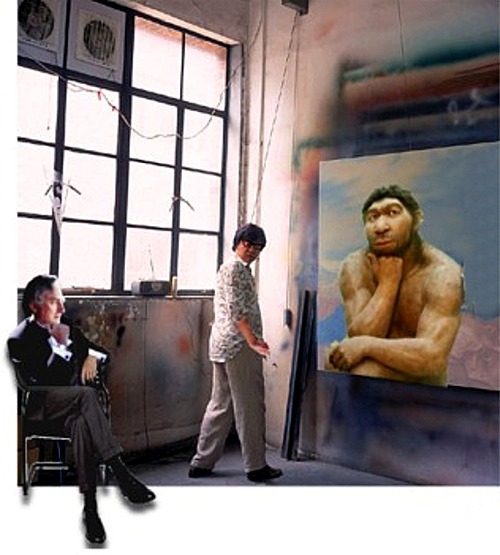
Neanderthals Interbred With Modern Humans


Scientists Lied and Real Neanderthals Died! Neanderthal DNA 99.97% Identical to that of Evolutionary Scientist’s!

Posted by Chris Parker
May 10 2010


A DNA study discussed in the article below proves that Neanderthals interbred with “modern” humans; thus Neanderthals belong in our species, Homo sapiens.

Metaphorically speaking, science has murdered the “Neanderthal”. They robbed him of his humanity. They portrayed him as little more than an animal; unable to speak, to sing, to create tools, to love their children or to care for their dead.
They were literally considered sub-human or non human. They were drawn as “hairy” (a sure sign of primitiveness), stooped, knuckle draggers. Science told us that those primitive “things” were wiped out by the smarter “humans” or often “modern humans”-a term that should soon be extinct.
I do not exaggerate about the impact of science’s assault on Neaderthal. In the recent history of the world, considering Black people sub-human aided the continuation of the instutution of slavery and considering people of Jewish descent an inferior species led directly to the Holocaust.
With the dehumanization of Neanderthal, the religion of evolution was boosted. Science needed primitive half-men to support their theory of man’s descent from apes. But, it was always a lie and though it has now been proven to be a lie, science is still attempting desperately to hold on to it.
Humans are one of the most genetically similar species living. The DNA of each person alive today is 99.99% genetically identical to that of the next person. A West African population of only 55 chimpanzees had twice the genetic diversity as the entire human race one geneticist pointed out.
Christians who had knowledge of this area of science have wondered what was going to become of the “Neanderthal as primitive cave-man” if ever DNA from Neaderthal was sequenced. If the account in Genesis is true, then we would expect that the DNA analysis would prove creationists correct and evolutionists wrong; that men were men and that there had been no evolution of mankind.
The initial conclusions from a study of Neanderthal DNA appeared to uphold the evolutionary view. The researchers erroneously concluded that there was No genetic connection between Neaderthal and “people”. That was a very popular conclusion, however, now that’s been flipped on its head. here is a quote from the article describing the new conclusions:


Svante Paabo, the geneticist at the Max Planck Institute for Evolutionary Anthropology in Leipzig, Germany, who spearheaded the study, said he now sees his ancestors in a new light. His initial research on a different type of DNA that contains far less information had concluded – incorrectly, it turns out – that Neanderthals have no genetic connection to people alive today.
The real conclusion is that Neanderthal was 99.97% identical to “modern” humans. Since only 60% of the actual genome was recovered, one can attribute the tiny difference either to errors in the science or one might conclude that men were very slightly more genetically diverse prior to the flood. Recent science articles have stated that we share 4% of our genes with Neanderthal. Other scientists insist that Neanderthal couldn’t speak. Scientists argued up to this year whether pollen found in Neaderthal graves indicated that they buried their dead with flowers. (Not very apelike behavior).
Some might argue that science or scientists didn’t “lie”. At worst, perhaps, maybe they were wrong but this was not intentional. We would say; there couldn’t have been evidence that Neandethal was sub-human, since as we all now know–he wasn’t it. There couldn’t have been evidence that he looked as he was portrayed, so to portray him that was was not “truth” and was now known by all to be obviously untrue. Lie: “a false statement made with deliberate intent to deceive; an intentional untruth; a falsehood. 2.something intended or serving to convey a false impression..dictionary.com
The false impression they wanted to create? That Neanderthals were primitive biologically- a fact that if true would have disproved Genesis. That evolution is true.
A recent comment on Panda’s Thumb, an evolutionary website wondered how the initial “wrong” conclusions were going to be spun by the “creos”. No doubt it is his along with the Darwinist’s heads that are now spinning….s8int.com

Study suggests humans mated with Neanderthals

By KAREN KAPLAN
Los Angeles Times
Published: Thursday, May. 6, 2010

LOS ANGELES — The first modern humans to leave Africa 80,000 years ago encountered Neanderthal settlements in the Middle East and – on at least some occasions – chose to make love instead of war, according to an international team of scientists who have pieced together the genetic code of humanity’s closest relatives.
Traces of that ancient DNA live on in most human beings today, the researchers report in Friday’s edition of the journal Science.
The finding, which was made by analyzing DNA from Neanderthal bones and comparing it to that of five living humans, appears to resolve a longstanding mystery about the relationship between Neanderthals and Homo sapiens, who coexisted in Europe and western Asia for more than 10,000 years until Neanderthals disappeared about 30,000 years ago.
“We can now say with absolute certainty that we’ve got these Neanderthal genes,” said John Hawks, an evolutionary geneticist at the University of Wisconsin who was not involved in the study. “They’re not ‘them’ anymore – they’re ‘us.’”
Svante Paabo, the geneticist at the Max Planck Institute for Evolutionary Anthropology in Leipzig, Germany, who spearheaded the study, said he now sees his ancestors in a new light. His initial research on a different type of DNA that contains far less information had concluded – incorrectly, it turns out – that Neanderthals have no genetic connection to people alive today.
Now, Paabo said, “I would more see them as a form of humans that were a bit more different than people are from each other today.”
Most important, scientists said, knowing the precise structure of the Neanderthal genome will help answer the fundamental biological question: What makes us human?
Neanderthal DNA is 99.7 percent identical to that of people, according to the analysis, which involved dozens of researchers. Something in the remaining 0.3 percent must make us unique.
“It’s not about understanding Neanderthals,” said genome biologist Ed Green, who led the study as a research fellow in Paabo’s lab and is now at the University of California at Santa Cruz. “It’s understanding us.”
By lining up the Neanderthal genome with DNA from humans and chimpanzees, Green and colleagues identified small changes that are unique to humans. Some were in genes involved in energy metabolism, skeletal structure and brain development, including four that are thought to contribute to conditions such as autism, Down syndrome and schizophrenia.
The researchers constructed the Neanderthal genome from three bone fragments found in Croatia’s Vindija Cave. Using a sterile dentistry drill, the scientists removed 400 milligrams of bone powder – an amount equivalent to the size of an aspirin.
Extracting DNA from ancient bones was a dicey proposition.
For starters, 95 percent to 99 percent of the DNA the team found came from microbes that colonized the bones after the Neanderthals died more than 38,000 years ago. To address that problem, the scientists discarded DNA fragments with letter combinations that were especially common in microbes.
In addition, the Neanderthal DNA was badly degraded, which caused sequencing machines to misread some of the chemical letters in the sequence. The researchers developed a computer program to correct those mistakes.
The researchers took special precautions to keep their own DNA out of the Neanderthal samples. Workers wore full-body suits, including masks and gloves. The air pressure inside the lab was kept high so that nothing could blow in accidentally, and the room was irradiated after the researchers went home, Green said.
After four years of work, the team identified 4 billion fragments of Neanderthal DNA and organized them into a draft genome. The sequence is 60 percent complete.
“It is a very poor quality for a human genome, but it is outstanding for a 30,000-year-old extinct hominid,” said Eddy Rubin, who has sequenced samples of Neanderthal DNA at Lawrence Berkeley National Laboratory but was not involved in the Science study.
To look for evidence of gene flow between humans and Neanderthals, the researchers sequenced the DNA of five people who now live in southern Africa, western Africa, France, China and Papua New Guinea. Since they didn’t think Neanderthals genes had passed to humans, they expected to find the same degree of difference between the Neanderthal genome and all five people.
Instead, they discovered that the Neanderthal DNA was slightly more similar to the three people living outside of Africa. Even more surprising, the relationship was just as strong for the individuals from China and Papua New Guinea as for the person from France, who lives in the Neanderthals’ old stomping grounds.
The simplest explanation is that a small group of humans met the Neanderthals 50,000 to 80,000 years ago after they left Africa but before they had spread throughout Europe, Asia and beyond. The logical meeting place was the Middle East, which connects northeast Africa to the Eurasian continent.
“The contact must have happened early for the Neanderthals genes to have spread so widely and uniformly,” Henry Harpending, an anthropologist at the University of Utah, who was not involved in the study.
The amount of mixing was small – only 1 percent to 4 percent of the DNA in non-African humans originated in Neanderthals, according to the study. The researchers said none of that DNA is functional; in fact, the particular 1 percent to 4 percent is different in every individual.
Interbreeding may well have continued in Europe, but that would be harder to detect because both populations there were large and any small Neanderthal contribution would be too dilute to see, Paabo said.

SOURCE
SEE ALSO Story 1
Story 2

Wednesday, June 12, 2013

Knowledge of Four Elements Pre-Dates Empedocles


Genesis 1:10 (BHS/WIVU)
וַיִּקְרָ֨א אֱלֹהִ֤ים׀ לַיַּבָּשָׁה֙ אֶ֔רֶץ וּלְמִקְוֵ֥ה הַמַּ֖יִם קָרָ֣א יַמִּ֑ים וַיַּ֥רְא אֱלֹהִ֖ים כִּי־טֽוֹב׃
wayiqra – elohim – layyabbashah – erets ulemiqweh – hammayim – qara – yammim – wayyareh – elohim – ki+tov
and (he) called – God – to the dry ground – earth and to collection – the waters – (he) called – seas – and (he) saw – God – for+good

The construction of this verse is familiar. See in particular this post on Genesis 1:4 regarding “seeing.”
Genesis 1:10 marks the last time in the creation narrative that God himself names things. Take a look at what he’s named: day & night (in 1:5), sky (in 1:8), earth and sea (here in 1:10). Are these meant to correspond to the four primal elements fire, air, earth, and water? Fire is perhaps a leap from day & night. But if the correspondence is intentional, God is shown to be the creator and fashioner of what was understood to be the substances from which everything else was formed until relatively recent history.
This is a pretty nifty observation, but it presents a small challenge to the historical-grammatical interpretation of Genesis 1. The problem is that the four primal elements idea is normally attributed to a Greek philosopher by the name of Empedocles who lived in the 5th century B.C. – about 1,000 years after Moses and the traditional date for the recording of Genesis. The Wellhausen hypothesis posits later dates for Genesis but is still 400 years before Empedocles.
We show our Western bias however when we focus on the Greeks. The Egyptians actually had a similar concept dating back to the late 3rd millennium B.C. (about 1,000 years before Moses and closer to the days of Abraham). The Egyptian idea was embodied in a group of deities called the Ogdoad, and the four primordial substances were darkness, air, the waters, and infinity/eternity.
All of this is to say that even from a purely secular standpoint it is not unreasonable to grant that the Greek primal elements concept existed in the Ancient Near East well before the Greeks. Is the periodic table a revolutionary modern invention or simply a late refinement in a long history of examining the structure of the universe? Of course, where Genesis 1 breaks with modern materialism is where it breaks with 3rd millennium B.C. Egyptian mythology. Those primal substances – whether they be the Ogdoad, or Empedocles’ four, or the 118 elements of the periodic table – did not always exist and should not be confused with the creator.
Here’s my translation: “And God called the dry ground ‘earth,’ and the collection of waters he called ‘seas’ and God saw that (this was) good.”
Extra credit: Note the first word of the second line transliterated ulemiqweh above. This is ule (“and to”) + miqweh (“collection”). In modern Hebrew pronunciation, miqweh becomes mikveh. This is the term for a ritual bath (see Leviticus 11:36), and the practice of immersing in a mikveh for ritual cleansing forms a basis for baptism in the New Testament. The baptisms that happen in churches around the world every week have a root in a word that goes back to the creation of the sea itself!

....

Taken from: http://revelationorbust.com/wordpress/?p=376#more-376

Friday, June 7, 2013

Transubstantiation into the Immaculate, in the Thought of St. Maximilian Kolbe


05FridayApr 2013


Posted by in Spirituality

....
 

Transformation into Our Lady has been spoken of by the saints for many centuries. In True Devotion to the Blessed Virgin, St. Louis de Montfort, repeats the words of St. Ambrose, writing, “The soul of Mary will be communicated to you to glorify the Lord. Her spirit will take the place of yours to rejoice in God, her Savior…”(1). It is St. Maximilian, however, who has given this transforming union its boldest and most descriptive formulation: “transubstantiation into the Immaculate.”
The Eucharistic terminology is very enlightening. St. Maximilian speaks of Mary’s devotees being changed, as it were, into Our Lady. One becomes, “in a certain sense, her living, speaking and working in this world” (2). Negatively, this means the uprooting of sin and imperfection. Positively, it entails growth in Charity and sanctity. “Let yourselves be led by the Immaculate, let Her form you with an ever greater freedom and you will become like Her, because She will make you ever more immaculate and She will nourish you with the milk of Her grace” (3).
At a certain point, this transforming union becomes so radical, the term “transubstantiation,” used analogously, becomes a very descriptive and accurate way to express the extent of Marianization. St. Maximilian writes, “We want to be so much the Immaculate’s that there remains nothing in us that is not Hers, that instead we come to be annihilated in Her, changed into Her, transubstantiated into Her, that She herself alone remains. That we might be thus Hers, as She is God’s” (4).
St. Maximilian thus draws an analogy between the relationship we seek to have with Our Lady, and her own union with God. Describing this union, he gives the Latin formulation: Filius incarnatus est: Jesus Christus. Spiritus Sanctus quasi incarnatus est: Immaculata (5). That is, “The Son is incarnate: Jesus Christ. The Holy Spirit is quasi incarnate: the Immaculata.” St. Maximilian elaborates:
The Holy Spirit manifests his share in the work of Redemption through the Immaculate Virgin who, although she is a person entirely distinct from him, is so intimately associated with him that our minds cannot understand it. So, while their union is not of the same order as the hypostatic union linking the human and divine natures in Christ, it remains true to say that Mary’s action is the very action of the Holy Spirit (6).
Mary’s actions are the very actions of the Holy Spirit, and as St. Maximilian points out elsewhere, the Holy Spirit acts always (by His own divine decree) through Mary. These two persons operate as if they are, so to speak, one person. This union is founded on the grace of the Immaculate Conception: Our Lady’s first grace, and that which radically conforms her to her Spouse, such that, in the words of St. Maximilian, she is the created Immaculate Conception, whereas the Holy Spirit is the Uncreated Immaculate Conception (7). The Blessed Virgin is a manifestation of her Spouse. St. Maximilian writes, “Just as the Son, to show us how great his love is, became a man, so too the third Person, God-who-is-Love, willed to show his mediation… by means of a concrete sign. This sign is the heart of the Immaculate Virgin…” (8).
Transubstantiation into the Immaculate means being changed into her, such that one’s actions are truly hers. We become concrete manifestations of the Blessed Virgin, “in a certain sense, her living, speaking and working in this world” (9). In this way, we become hers, as she is God’s.
Both the positive and negative dimensions of this transubstantiation are achieved through total consecration to the Immaculate. Such a consecration means entrusting ourselves to her maternal Heart; placing all of our goods, corporeal and spiritual, at her disposal; and doing everything for her honor. It further entails a real striving to imitate Our Lady interiorly and exteriorly, and to fulfill her will in all things. “Let us strive to live in such a way that every day, every moment, we become ever more the property of the Immaculate, fulfilling always more perfectly the will of the Immaculate” (10).
It is interesting to note that St. Maximilian promoted total consecration without having knowledge of St. Louis de Montfort’s True Devotion. He became familiar with this classic little treatise only later in life. Instead, his devotion is drawn from the Franciscan tradition, which profoundly shaped all of his theological insights. He wrote to a confrere:
For seven centuries we strove for the recognition of the truth of the Immaculate Conception, and our efforts were crowned with the proclamation of the dogma and the apparition of the Immaculate at Lourdes. Now we move on to the second part of the story: the sowing of the seed of this truth in souls, fostering its growth and ensuring that it produce fruits of sanctity. And this in all souls who are and who will be until the end of the world (11).
In St. Maximilian’s view, the Immaculate Conception may be likened to a blueprint. In the first chapter of Franciscan history, the order strove to make this blueprint known by all the Church‒ an effort which ended with a definitive victory in 1854. Now, according to St. Maximilian, the blueprint must be implemented throughout the Church by means of Marian consecration. With this consecration, lived out authentically, the faithful can be increasingly transubstantiated into the Immaculate, and thus, patterned ever more closely on the Immaculate Conception‒ Our Lady herself.
The more this transformation takes hold, the more one becomes, as it were, an extension of Mary. The soul acquires an increasingly profound insertion into the depths of the Holy Trinity. Exteriorly, however, the person appears no different from any other. Here we see again, how carefully chosen and enlightening St. Maximilian’s terminology really is. At Holy Mass, the accidents of bread and wine remain in place, even after the consecration. Likewise, transubstantiation into the Immaculate entails a radical change, but leaves the exterior appearance intact. No one could guess, simply by looking at a true Marian devotee, the degree to which his soul is flooded with grace.
The analogy is likewise instructive as to the proper mode of evangelization for Catholics. If one’s sanctity consists in being Marianized, then hiding the truth about Our Lady amounts to concealing the means of sanctification. Obfuscating Mary’s necessity, beauty, and queenship, can be likened to hiding the truth about the Blessed Sacrament.
St. Maximilian’s formulation, “transubstantiation into the Immaculate,” also draws attention to the relationship between the Holy Eucharist and the Blessed Virgin. Eucharistic mediation is profoundly Marian, and Marian mediation cannot be other than Eucharistic. Jesus and Mary are indissolubly united, including in the Blessed Sacrament and, “Therefore what God has joined together, let no man separate,” (12).
The Church and Our Lord are united in a spousal manner. As in all spousal unions, however, a real distinction remains. The Personhood of Christ is that of the Son of God, while the personality of the Church is strictly Marian. Herein lays the distinction between Christ and the Church. Reflection on this point cannot fail, however, to also shed light on the union between Christ and His Church, since, “Jesus and Mary always go together,” as St. Bernadette puts it.
The genius of St. Maximilian’s terminology lies, in part, in his succinctly locating the Christification of the Church (we might say, transubstantiation into the Eucharist), and each of its members, precisely in Marianization. The Holy Spirit is the “Soul” of the Church, and Our Lady is the Spouse, or better still, Quasi-Incarnation, of the Holy Spirit. This accounts for the Marian presence which pervades the entire Church, which Bl. John Paul II writes of in Redemptoris Mater. It also illustrates why sanctification‒ that is, Christification‒ can only mean Marianization.
The reflections and insights of the Franciscan saints on Our Lady have developed within a unique, yet thoroughly Catholic tradition. The thought of St. Maximilian is no exception. His insights, like those of St. Bonaventure, Bl. John Duns Scotus, St. Bernardine of Siena, and St. Leonard of Port Maurice, have developed in a manner congruous with the charism and spirituality of the Seraphic Father. It has rightly been said that Franciscan theology flows from the stigmatized heart of St. Francis.
The content of Franciscan Mariology can be found in the thought of St. Francis himself, albeit, stripped of academic terminology. He calls Our Lady the “Spouse of the Holy Spirit” rather than the Immaculate Conception; instead of Co-redemptrix, “Handmaid”; and rather than Type or Exemplar of the Church, “Virgin made Church.” These themes have formed the core of Franciscan Mariological thought, centered on the Immaculate Conception as the metaphysical basis for Marian mediation‒ both in its mode (virginal-maternal, whether we speak of the objective or subjective redemption) and in its end, namely, the growth of the Church and each of its members into the likeness of the Immaculate.
The thought of St. Maximilian represents a simple development in this Mariology. At San Damiano, Christ gave St. Francis, and the Franciscan Order, a mission: “Rebuild my Church.” Franciscans of every age have held that Mary, qua Immaculate Conception, is both the blueprint to be followed and the means of success in this mission.

Notes
(1) Bay Shore, NY: Montfort Publications, 2001, p. 112
(2) SK# 486
(3) SK# 1334
(4) SK# 508
(5) Bonamy, 63, quoting from Sketch by Kolbe, 1940
(6) Miles Immaculatae. I, 1938. Emphasis added
(7) H. M. Manteau-Bonamy, O.P., Immaculatae Conception and the Holy Spirit, trans. Richard Arnandez, F.S.C. (Kenosha, Wisc.: Prow Books/Franciscan Marytown Press, 1977), 2-3, quoting from Final Sketch
(8) Miles Immaculatae. I, 1938
(9) SK# 486
(10) SK# 1232
(11) SK# 485
(12) Mark 10:9

Jesus Christ "divided all human history into two, into "B.C." and "A.D.""

Philosophy of Jesus, The

Kreeft, Peter

Amazingly, no one ever seems to have looked at Jesus as a philosopher, or his teaching as philosophy. Yet no one in history has ever had a more radically new philosophy, or made more of a difference to philosophy, than Jesus. He divided all human history into two, into "B.C." and "A.D."; and the history of philosophy is crucial to human history, since philosophy is crucial to man; so how could He not also divide philosophy?
Philosophy of Jesus, The

....
Taken from: http://www.staugustine.net/our-books/books/the-philosophy-of-jesus/