“Cosmology matters, it has a decisive impact upon our spiritual condition.
Even what we think about the purely physical world turns out to be crucial;
for indeed, “unless a man’s concept of the physical universe accords with reality,
his spiritual life will be crippled at its roots. . . .”
This article is not meant to be anti- any legitimate science or scientific endeavour.
It is against pseudo-science, certainly, but also the mis-use of science. Damien F. Mackey.
The scientific Weltanschaaung has entered into, and has greatly affected, even how we in the ‘West’ interpret the sacred Scriptures. And this not withstanding the fact that the Old and New Testaments were written by (i) ancient scribes; (ii) who thus were not of the modern ‘West’; and (iii) who wrote in ancient languages.
Regarding this unhappy state of affairs, ‘the modern tendency to reduce everything to science’, I had cause to quote Tim Martin in e.g. my article:
Was the Flood literally global?
We live in a world dominated by materialism and scientism. The reduction of every aspect of life to “science” has corrupted the soul of Western Civilization. This is one key to understanding the related popularity of both futurism and Creation Science. They are both perfectly compatible with the scientistic spirit of the modern age. In fact, dispensational futurism, at least, is impossible apart from it. Christians aid this scientistic syncretism through Creation Science methods of reading Scripture. They do it by reducing even the language of the Bible to the “scientific.” ….
Viewed in this light it is not difficult to see that Creation Science ideology is a right-wing form of modernism. Conrad Hyers puts it this way:
Even if evolution is only a scientific theory of interpretation posing as scientific fact, as the creationists argue, creationism is only a religious theory of biblical interpretation posing as biblical fact. To add to the problem, it is a religious theory of biblical interpretation which is heavily influenced by modern scientific, historical, and technological concerns. It is, therefore, essentially modernistic even though claiming to be truly conservative. ….
[End of quotes]
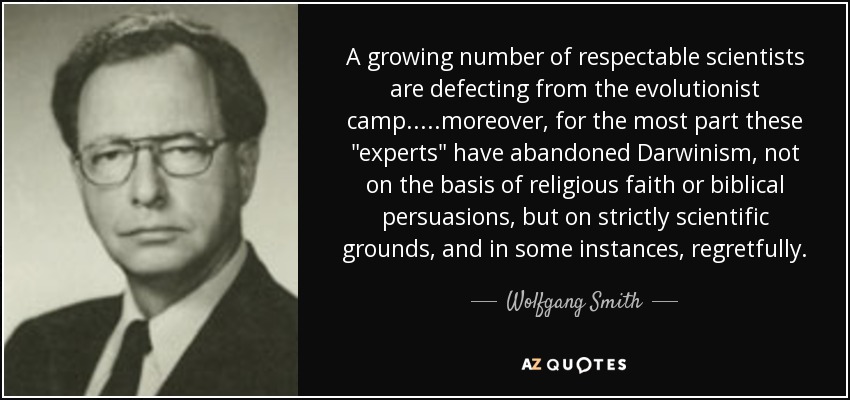
Wolfgang Smith, mathematician, physicist, philosopher of science, metaphysician, has written brilliantly on the plague of scientistic belief at:
...
I will go so far as to contend that religion goes astray the moment it relinquishes its just rights in the so-called natural domain nowadays occupied by science. I believe that the contemporary crisis of faith and the ongoing de-Christianization of Western society have much to do with the fact that for centuries the material world has been left to the mercy of the scientists. This has of course been said many times before (but not nearly often enough!). Theodore Roszak, for instance, has put it exceptionally well: “Science is our religion,” he observed, “because we cannot, most of us, with any living conviction see around it.” …. And one might add that perhaps only those who already have at least a touch of authentic religion do in fact stand a chance of “seeing around it with any living conviction.”
So too the name of Oskar Milosz (1877-1939) comes to mind, a European writer who had this to say: “Unless a man’s concept of the physical universe accords with reality, his spiritual life will be crippled at its roots, with devastating consequences for every other aspect of his life.” …. It could not have been better said! As regards the implications of the scientistic world-view for the life of the Church, let me quote from a recent book by the French philosopher Jean Borella: “The truth is that the Catholic Church has been confronted by the most formidable problem a religion can encounter: the scientistic disappearance (disparition scientifique) of the universe of symbolic forms which enable it to express and manifest itself, that is to say, which permit it to exist.” And he goes on to say: “That destruction has been effected by Galilean physics, not, as one generally claims, because it has deprived man of his central position—which, for St. Thomas Aquinas is cosmologically the least noble and the lowest—but because it reduces bodies, material substance, to the purely geometric, thus making it at one stroke scientifically impossible (or devoid of meaning) that the world can serve as a medium for the manifestation of God. The theophanic capacity of the world is denied.” …. Let us be clear about it: Borella is pointing the finger squarely at what I have termed physical reductionism: “le problème le plus redoubtable qu’une religion puisse rencontrer,” he calls it. What he terms a “reduction to the purely geometric” corresponds precisely to what I call the reduction of the corporeal to the physical: it is this scientistic contention that would obliterate “the theophanic capacity of the world.”
It is of course to be understood that the “symbolic forms” to which Borella refers are not, as some might think, subjective images or ideas which in days gone by men had projected upon the external universe, until, that is, science came to apprise us of the truth. The very opposite is in fact the case: The “forms” in question are objectively real and indeed essential to the universe. We may conceive of them as “forms” in the Aristotelian and Scholastic sense, or Platonically, as eternal archetypes reflected on the plane of corporeal existence. In either case they constitute the very essence of corporeal being. Remove these “symbolic forms,” and the universe ceases to exist; for it is these “forms,” precisely, that anchor the cosmos to God.
It is needless to point out that science has not in reality destroyed these forms, or caused their disappearance; however, the scientistic negation of corporeal being entails a denial of the substantial forms or essences which constitute that order of being, and of the sensible qualities by which these forms or essences manifest themselves to man. The scientistically prepared mind, therefore, has become increasingly insensitive to what Borella terms “the universe of symbolic forms,” to the point where that universe has become for it all but invisible. It is in that sense that the “theophanic capacity of the world” has been diminished to an unprecedented degree.
The consequences, however, of that diminution cannot but be tragic in the extreme. In his denial of essences, scientistic man has destroyed the very basis of the spiritual life. As Borella points out, he has obliterated the domain “that enables the Church to express and manifest itself,” and hence “permits it to exist.” The refutation of scientistic belief, therefore, is not an optional matter for the Church, something from which she can afford to abstain; it is rather a matter of urgent necessity, a question ultimately of survival.
It may be well, finally, to reflect anew upon what St. Paul has to say concerning “the theophanic capacity of the world” in his letter to the Romans. “For the invisible things of him from the creation of the world are clearly seen,” he declares, “being understood by the things that are made, even his eternal power and Godhead.” To which he adds: “So they are without excuse:
Because that, when they knew God, they glorified him not as God, neither were they thankful; but became vain in their imaginations, and their foolish heart was darkened. Professing themselves to be wise, they became fools” (Rom. 1:20-22).
I need hardly point out the striking relevance of these words to all that we have discussed. The “things that are made” are doubtless corporeal natures, the objects that man can perceive; and what about “the invisible things of him”: are these not precisely eternal essences, ideas or archetypes? So long as man’s heart has not been “darkened,” the sensory perception of “things that are made” will awaken in him an intellectual perception—a “recollection,” as Plato says—of the eternal things which the former reflect or embody. St. Paul alludes to a time or a state when man “knew God,” a reference, first of all, to the condition of Adam before the fall, when human nature was as yet undefiled by original sin. One needs to realize, however, that the fall of Adam has been repeated on a lesser scale down through the ages, in an unending series of “betrayals,” large and small. Even today, at this late stage of history, we are, each of us, endowed with a certain “knowledge of God” to which we can freely respond in various ways. And that is precisely why we, too, are “without excuse,” and why, to some degree at least, we are responsible for the opinions we hold concerning the cosmos. Everyone perceives the universe in accordance with his spiritual state: the “pure in heart” perceive it without fail as a theophany; and for the rest of us, whose “foolish hearts are darkened,” the theophanic capacity of the universe is reduced in proportion to this darkening.
I would like however to emphasize that this correspondence between our spiritual state and our Weltanschauung applies in both directions, which is to say that not only does our spiritual state affect the way we view the external world, but conversely, our views concerning the universe react invariably upon that state. This is in fact my central point: Cosmology matters, it has a decisive impact upon our spiritual condition. Even what we think about the purely physical world turns out to be crucial; for indeed, “unless a man’s concept of the physical universe accords with reality, his spiritual life will be crippled at its roots. . . .”
This brings us at last to the pastoral question: what can be done pastorally to counteract the scientistic influence? The major problem, clearly, is to inform the pastors themselves: to alert them, first of all, to the fact that there is a crucial distinction to be made between science and scientism, and then to the fact that scientistic belief is antagonistic to our spiritual well-being. This however will not be easy to get across, for it offends against the prevailing trend, both in civil society and within the Church. It is only by an act of grace, I surmise, that any of us are able to muster the discernment, and indeed the sheer boldness, to cast off the scientistic Weltanschauung and recover a Christian world-view. And this task, this imperative, I say, is at bottom spiritual. It is to be accomplished, thus, not simply by reading books, or through a process of reasoning, but above all through faith and prayer. The dictum credo ut intelligam applies to us still, and perhaps even more urgently than in the comparatively innocent days of Augustine or Anselm. It is needful that we be touched and enlivened by the Holy Ghost, the Spirit of truth, who “will guide you into all truth” (John 16:13). In our struggle to transcend the scientistic outlook, we are dealing, moreover, not simply with a belief system of human contrivance, but with something more formidable by far; for here too, in the final count, “we wrestle not against flesh and blood, but against principalities, against powers, against the rulers of the darkness of the world, against spiritual wickedness in high places” (Eph. 6:12). How could it be otherwise when it is “the theophanic capacity of the world” that stands at issue: the very thing “which enables the Church to express and manifest itself, that is to say, which permits it to exist.” ….

 Until the day she saw something that changed everything, a baby fighting for its life. This led Abby Johnson to join her former enemies at 40 Days For Life and become one of the most ardent pro-life speakers in America.