Monday, June 3, 2019

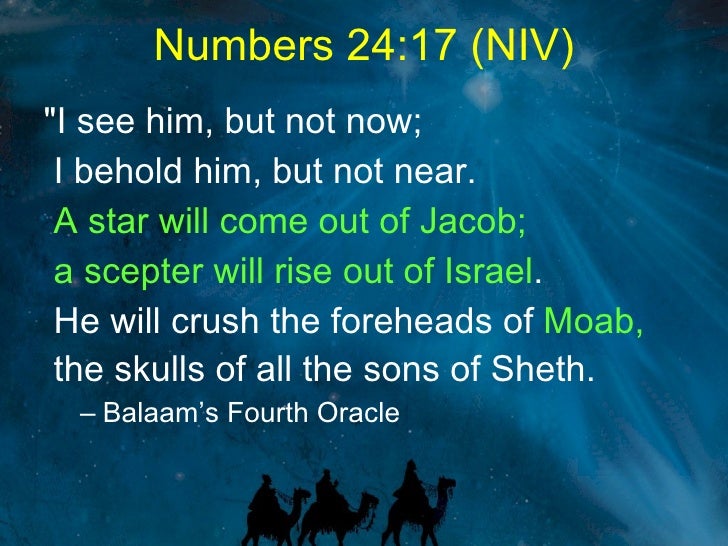
‘There shall come a Star out of Jacob’


 Image result for star out of jacob
 
 
The Law, we are told by St. Paul, has “a shadow of the good things to come”
(Hebrews 10:1). The various ordinances and feasts of the Old Testament,
if properly understood, are found, according to G. Mackinlay, “to refer to
and foreshadow many events and doctrines of the New Testament”.


Previously I have written (summarising Lieutenant-Colonel G. Mackinlay’s important book, The Magi: How They Recognised Christ's Star, Hodder and Stoughton, 1897):
 
….
Chapter Three: “A Star … out of Jacob”
 
Let us now turn again to the method of inferences from harmonies, that we have used in the last two chapters, in order to determine, with greater precision than has been attained do far, the date of Our Lord’s Nativity. Despite Scaliger, who said that God alone, not man, can determine the true day of the Nativity (Scaliger, as quoted by Hales, Chron., Vol. 1, p. 199), we are prepared to accept a result arising clearly and consistently from the method of harmonies – should such a result be achieved – provided, of course, that the result does not clash with, or contradict, any well–established fact of history. And we can look upon this further application of the method of inferences from harmonies as being a further test of the reliability of this method of inference.
We shall investigate historical methods later on.
 
Mackey’s comment: Actually the needed revision of late BC-early AD history, not yet effected, may be far more radical than earlier writers, like Mackinlay, could possibly have imagined. As Mackinlay saw it, it was universally accepted that Our Lord’s Nativity could not have been earlier than the beginning of BC 10, or later than the end of BC 5. The date is today generally given as being somewhere between BC 8-4.
But see my radical revision of all of this:
 
A New Timetable for the Nativity of Jesus Christ
 
 
“Chronologists have never really managed to sort out a satisfactory biblical timeline for this Roman scenario, with the Nativity currently having to be positioned in BC time (8 BC, 4 BC) to accommodate a faulty Herodian chronology.
But it is Jesus Christ the Lord of History, the Alpha and the Omega (the Aleph and the Tau), and not king Herod, who determines the end point of BC time and the beginning of AD (Anno Domini) time”.
 
In pursuing these new inferences now for the earlier part of Our Lord’s life, we once again follow our reliable guide Mackinlay who commences by establishing “the greater probability” of the following two facts:
 
(a) That the Nativity of Our Lord was at least five months after the beginning of a period of shining of the morning star, and,
(b) That the Nativity was at a Feast of Tabernacles (p. 140).
 
Firstly, we investigate Mackinlay’s reason for believing that our Lord’s Nativity was:
 
(a) Five months after a period of shining.
To begin with, we must consider what reason there is for supposing that the morning star was shining at all when Our Lord was born. In Malachi 3:1 … St. John the Baptist is referred to under the figure of the morning star, as the forerunner of the Christ. But the morning star itself may be called “My messenger who shall prepare the way before Me”. It is not unusual for inanimate objects thus to be spoken of in Scripture, for instance in Psalm 88:38 we have “the faithful witness in the sky”, and in Psalm 148:3 the sun, moon and stars of light are exhorted to praise God. Consequently, as Mackinlay has explained it (p. 141), “we can reasonably suppose that the Morning Star was shining at the Nativity”. Furthermore, he adds, if the morning star were the herald of the coming One, it is fitting to imagine that a somewhat prolonged notice should be given; for “it would be more dignified and stately for the one to precede the other by a considerable interval, than that both should come almost together”.
We shall find Mackinlay’s supposition of a prolonged heralding by the morning star borne out by the following inference. According to the principle of metaphors being taken from things present, we could infer that the morning star was actually shining when Our Lord (in Matthew 11:10), quoting Malachi 3:1, spoke of the Baptist as “My messenger … before My face”. Consistently following the same line of thought, we may reasonably infer that the morning star was also shining more than thirty years earlier when Zechariah quoted the same scriptural verse – i.e. Malachi 3:1 – at the circumcision of his son, John (Luke 1:76).
Even had this appropriate passage not been quoted at the time, Mackinlay suggests (p. 142), “we might have inferred that the herald in the sky would harmoniously have been shining at the birth of the human herald”.
Mackinlay further suggests from his inference that both Our Lord and St. John were born when the morning star was shining, that “both must have been born during the same period of its shining”. [He shows this in his charts]. The Annunciation to Mary was made by the angel Gabriel in the sixth month after the announcement to Zechariah (Luke1:13, 24, 26); and so it follows that the Baptist was born five to six months before Our Lord. Since Mackinlay’s charts indicate that the periods of shining are separated from each other by intervals of time greater than six months, then both Our Lord and his herald must have been born during the same period of shining.
Consequently Our Lord was born at least five months after the beginning of a period of shining of the morning star. ….
 
(b) At a Feast of Tabernacles
The Law, we are told by St. Paul, has “a shadow of the good things to come” (Hebrews 10:1). The various ordinances and feasts of the Old Testament, if properly understood, are found, according to Mackinlay, “to refer to and foreshadow many events and doctrines of the New Testament” (p. 143). Again, A. Gordon remarks that: “Many speak slightingly of the types, but they are as accurate as mathematics; they fix the sequence of events in redemption as rigidly as the order of sunrise and noontide is fixed in the heavens” (The Ministry of the Spirit, p. 28).
The deductions drawn from Gospel harmonies attest the truth of his statement.
We have already observed that the Sabbath Year began at the Feast of Tabernacles; the great feasts of Passover and Weeks following in due course. Our Lord’s death took place at the Passover (Matthew 27:50), probably, Mackinlay believes, “at the very hour when the paschal lambs were killed”.
“Our Passover … has been sacrificed, even Christ” (1 Corinthians 5:7); the great Victim foretold during so many ages by the yearly shedding of blood at that feast. The first Passover at the Exodus was held on the anniversary of the day when the promise – accompanied by sacrifice – was given to Abraham, that his seed would inherit the land of Canaan (Exodus12:41; Genesis 15:8-18).
Our Lord rose from the dead on the day after the Sabbath after the Passover (John 20:1); the day on which the sheaf of first fruits, promise of the future harvest, was waved before God (Leviticus 23:10, 11). Hence we are told by St. Paul that as “Christ the first-fruits” (1 Corinthians 15:20. 23) rose, so those who believe in him will also rise afterwards. This day was the anniversary of Israel’s crossing through the Red Sea or “Sea of Reeds’ (Exodus 12-14), and, as in the case of the Passover, it was also a date memorable in early history, being the day when the Ark came to rest on the mountains of Ararat (Genesis 8:4). The month Nisan, which had been the seventh month, became the first at the Exodus (Exodus 12:2). Thus Our Lord’s Resurrection was heralded by two most beautiful and fitting types, occurring almost – possibly exactly – on the same day of the year; by the renewed earth emerging from the waters of the Flood, and by the redeemed people emerging from the waters of the “Sea of Reeds”.
The next great event of the Christian dispensation, the Descent of the Holy Spirit (Acts 2:1, 2), occurred at the Feast of Weeks – or Harvest – or Pentecost (Leviticus23:15, 16). It was during this season that the Law had been given to Moses on Mount Sinai (Exodus 19:1, 10, 11). It is noteworthy, therefore, that the inauguration of the New Covenant took place on the anniversary of the establishment of the Old Covenant; showing that the dispensation of Law was superseded by that of the Holy Spirit (Hebrews 8:7; 2 Corinthians 3:6).
Accordingly, “since there is such manifest deign in the timing of Our Lord’s Death and Resurrection and of the descent of the Holy Spirit”, Mackinlay suggests that “the Nativity may well have occurred at the remaining great Feast of the Lord – at that of Tabernacles, which began the Sabbath Year” (p. 145). Having said this, Mackinlay proceeds to search for any harmonies that there may be between the characteristics of this Feast of Tabernacles and the events recorded in connection with the Nativity. As we have noticed previously, he says (p. 146), there were two great characteristics of the Feast of Tabernacles: 1. Great joy and 2. Living in booths (tents).
 
1. Great joy.
The Israelites were told at this feast, “You shall rejoice before the Lord your God” (Leviticus23:40), and “You shall rejoice in your feast … you shall be altogether joyful” (Deuteronomy16:14, 15). King Solomon dedicated his Temple on a Feast of Tabernacles, and the people afterwards were sent away “joyful and glad of heart” (1 Kings 8:2, 66; 2 Chronicles7:10).
There was no public rejoicing at the Nativity of Our Lord, however; on the contrary, as Mackinlay notes, “shortly afterwards Herod was troubled and all Jerusalem with him” (Matthew 2:3)”. But though Our Lord was rejected by the majority, we find the characteristic joy of Tabernacles reflected in the expectant and spiritually-minded souls. Before the Nativity both the Virgin Mary and Elizabeth rejoiced in anticipation of it (Luke 1:38, 42, 44, 46, 47). At the Nativity an angel appeared to the shepherds and brought them good tidings of great joy; and then “suddenly there was with the angel a multitude of the heavenly host praising God, and saying, ‘Glory to God in the highest’.” The shepherds then came to the infant Saviour and returned “glorifying and praising God” (Luke 2:9-20).
Forty days after the Nativity, at the Purification, Simeon, who had been waiting a long time for the consolation of Israel, and the venerable Anna who was a constant worshipper, joined in with their notes of praise and gladness (Luke 2:22-38).
And lastly the wise men from the East “rejoiced with exceeding great joy” when they saw the star indicating where the Saviour was, and they came into the house, saw the young Child with his Mother, and presented the gifts that they had brought (Matthew 2:9-11).
 
2. Living in Booths.
The command given to the Israelites concerning the observance of the Feast of Tabernacles was: “You shall dwell in booths for seven days” (Leviticus23:42). We also read, “In the feast of the seventh month … all the congregation … made booths, and dwelt in the booths” (Nehemiah8:14, 17).
According to Mackinlay (pp. 147-148), the living in booths finds a parallel in the language of the Apostle John, when he wrote concerning the Birth of Our Lord, “The Word became flesh, and tabernacled among us” (John 1:14); and Our Lord himself used a somewhat similar figure when he spoke of his body thus “Destroy this Temple, and in three days I shall raise it up” (John 2:19) – words misunderstood by his enemies and afterwards quoted against him (Matthew 26:61; 27:40).
It was at the Feast of Tabernacles that the glory of God filled the Temple that King Solomon had prepared for Him (2 Chronicles 5:3, 13, 14), and it would seem to have been at the beginning or first day of the feast, the fifteenth day of the month.
Consequently, in Mackinlay’s opinion (p. 148) “it would appear to be harmonious that the Advent of the Lord Jesus in the body divinely prepared for him (Hebrews 10:5) should also take place at the same feast and most suitably on the first day of its celebration”.
It will be noticed that the glory of God did not cover the tent of meeting when the Israelites were in the wilderness, and did not fill the tabernacle, at the Feast of Tabernacles. But it did so on the first day of the first month of the second year after the departure from Egypt (Exodus 40:17, 34, 35). We must remember that there was no Feast of Tabernacles in the wilderness, nor was the Sabbath Year kept at this stage; but both of these ordinances were to be observed when the Israelites entered into the Promised Land (Exodus 34:22). No agricultural operations were carried out during the forty years of wandering in the wilderness.
As the Feast of Tabernacles inaugurated the Sabbath Year, Mackinlay judged (p. 149) that the glory of God filled the temple on the first day of the feast, “as that would be in harmony with what happened in the tabernacle in the wilderness when the glory of the Lord filled it on the first day of the only style of year then observed”. A. Edersheim, writing about the Feast of Tabernacles, says (The Temple, note on p. 272): “It is remarkable how many allusions to this feast occur in the writings of the prophets, as if its types were the goal of all their desires”.
 
Mackey’s comment: What follows next, whilst serving as a guide, cannot be taken in strict numerical terms, I would think, given the present feeble state of biblico-historical reckoning, preventing us from archaeoastronomical retrocalculations.
 
Having come thus far, we are able - within Mackinlay’s context - to arrive at a still tentative, but very reasonable, conclusion: and this conclusion will later be strengthened very greatly, particularly when we look at the historical facts. Mackinlay at this stage analyses those years, BC 10-5, which are universally accepted as being the only possible ones for the date of Our Lord’s birth, to determine which of them fits the best (p. 150). Since it has been inferred that the Nativity occurred at a Feast of Tabernacles – probably on the first day – and that the morning star had been shining by then for at least five months, a glance at Mackinlay’s chart informs us that the only year within the possible historical limits that satisfies these conditions, in his context, is BC 8.
For we will notice that at the Feast of Tabernacles – say the autumnal equinox – of:
 
BC 10, the morning star was only just beginning its period.
BC 9, there was no morning star at all.
BC 8, the conditions are satisfied completely.
BC 7, there was no morning star at all.
BC 6, there was no morning star at all.
BC 5, the morning star had been shining only for about four months previously.
 
According to Mackinlay, the Feast of Tabernacles, BC 8, presents the further harmony that it was specially suited to the occasion, “as it was the first after a Sabbath year, and consequently a specially joyful one”. Thus, he says (pp. 150-151), even if we neglect the consideration of the Morning Star, we still have the Feast of Tabernacles BC 8 indicated for the date of the Nativity by the method of Gospel harmonies with the Sabbath year”.
….
 

Philosophy and Science – mutually autonomous

        
Image result for philosophy and science 


“Philosophy is called to judge pseudo-philosophical theories proposed in the name
of science, but the two disciplines are autonomous because they have different objects
and employ very different methods”.


Taken from:
http://www.kolbecenter.org/index.php?option=com_content&view=article&id=221:philosophy-and-science-in-contemporary-culture&catid=10:articles-and-essays&Itemid=74


Sunday, 17 March 2002 05:00
Author: Josef Seifert


SUMMARY OF PHILOSOPHY AND SCIENCE IN THE CONTEXT OF CONTEMPORARY CULTURE
By Josef Seifert (Full text article from Dr. Seifert can be requested at hugh@kolbecenter.org


….

Summarized by Rev. Victor P. Warkulwiz, M.S.S.
In this paper Professor Seifert examines the role of philosophy and science in shaping the image of man and in forming culture in the contemporary world, for the formation of a correct image of man and a respect for human dignity are of crucial importance as we enter the third millennium. Specifically, he concentrates on two opposite images of man derived from philosophy and science. One poses a threat to civilization; the other provides hope.

Professor Seifert observes: “Science and philosophy are not only parts of culture but they also shape decisively most of the other manifold cultural and artistic expressions as well as the ethical standards and laws, along with political actions and systems, of a given civilization”.

Philosophy and science exercise a vast influence on culture and moral standards. They strongly influence the popularly accepted image of the human person and society’s vision of man’s place in the cosmos. On the one hand, philosophers and scientists have made many contributions to what Pope John Paul II calls the “culture a life,” a culture formed by the Christian faith. On the other hand they have a large share of the responsibility for the ghastly “culture of death” that surrounds us.

Ultimately, the opposition is between a culture in which man is recognized as a human person made in the image and likeness of God and a culture built on an image of man as machine, a mere product of matter and chance. Professor Seifert begins the development of his theme by discussing the nature of philosophy and science. He makes the Platonic distinction between “authentic and certain knowledge” and “unfounded or insufficiently founded opinion.” Science, in its traditional and broadest sense, is directed towards the former. For Plato, the highest object of all science and knowledge is the supreme and absolute Good, which is the source of all authentic culture. Only knowledge that reaches truth about the good of man and the absolute Good can be, according to Plato, science in the full sense.

Today, the term science is applied almost exclusively to natural science. Furthermore, modern science consists of knowledge in the genuine sense along with many theories, paradigms, constructs and philosophical interpretations that are frequently false. It is a mixture of “authentic and certain knowledge” with “unfounded or insufficiently founded opinion.” And there is an increasing subjectivization of certainty in the thought in some modern philosophers of science that is moving toward the ideal of a purely hypothetical science without any certainty. Empiricist philosophy abandons the search for truth and reduces science to opinion and hypotheses subject to falsification.

Professor Seifert’s reflections favor a philosophy of science that upholds the high values of truth and certainty, a philosophy that is not a mere handmaid of science but one that orders science and distinguishes between “authentic and certain knowledge” and ‘unfounded or insufficiently founded opinion.” He goes on to make the distinction between philosophy and science. Philosophy is called to judge pseudo-philosophical theories proposed in the name of science, but the two disciplines are autonomous because they have different objects and employ very different methods. Philosophers study necessary natures, and natural scientists study non-necessary natures. Philosophic methods are unable to investigate such natures as those of animals or chemical elements. Such natures are non-necessary and must be studied using the empirical methods of natural science. Conversely, it would be absurd to study questions of ethics and oughtness by means of empirical studies of human or animal behavior. Scientists cannot solve philosophical problems by observation and experiment. Philosophy studies the intelligible and necessary aspects of reality, which are not susceptible to empirical methods.
Natural science studies the sensible and contingent aspects of reality. In the past some influential philosophers, such as Aristotle, have attempted to solve empirical problems by philosophic methods, thereby closing many minds to experimental sciences. But today philosophers are much less prone to intrude into the sphere of empirical matters than are scientists to pontificate about philosophical questions. Seifert gives a number of examples in which scientists tread on areas proper to philosophy. Konrad Lorenz and Wolfgang Wickler wrongly deduce ethical conclusions from observations of animal behavior. Albert Einstein ventures outside the domain of natural science when he speculates about the essence of time and the relativity of simultaneity. The same is true about the quantum physicist Werner Heisenberg when he makes far-reaching philosophical deductions regarding indeterminacy, freedom, causality and the first principles of being. Jacques Monad in his Chance and Necessity makes outrageous metaphysical claims about chance, necessity and God. And the theory of evolution is, in most of its forms, a philosophical theory for which scientific research provides at most a starting point.

False philosophical theses that are blindly held by scientists as if they were empirically demonstrated become the source of many errors. The mutual autonomy of philosophy and science, however, does not mean that they are completely independent of each other. Scientists presuppose many philosophical categories such as reality, existence, proof, argument, logical laws, matter, space, time, indeterminacy, determinism and finality. Only philosophy can give express answers to philosophical problems concerning truth, the scope and purpose of each science, and the value and limits of scientific knowledge.

Seifert states that the work of physicist/historian of science Stanley Jaki shows that only a creationist metaphysics, which sees the origin of nature in a free divine act and therefore recognizes contingency in nature, is able to provide the proper metaphysical basis for the empirical sciences. The philosopher is called to be a critic of science. But he also profits from science in many ways. Philosophical questions are presented by science to the philosopher. Experience has a different role for philosophy than it does for natural science. It can widen the scope of philosophy and confirm its conclusions. Philosophers can be pleased when the experiments of the scientists corroborate the results of their philosophical studies. But the philosophical method is never the experiment. It is another kind of knowledge. It is insight into the highly intelligible and evident essences and states of affairs; it is knowledge of existing beings in cognition and the knowledge of other persons through empathy; and it is knowledge acquired from deductive demonstrations.

Everything discussed so far was in preparation for the main topic, viz.: “the image of man provided by scientific knowledge in the described sense of science.” Professor Seifert next discusses the theory of evolution as an example of scientifically inspired “unfounded or insufficiently founded opinion.” He says that the theory of evolution is one of the most widespread and dangerously confused philosophical opinions thought up by scientists. “The evolutionary account of the origin of all living things possibly shaped the image of man on which contemporary culture rests more profoundly than any other scientific or pseudo-scientific theory.” He distinguishes two elements in the theory of evolution. The first concerns the trans-species development of organic beings, which can be confirmed or refuted by observation and experiment. The second concerns the causes and principles that bring about trans-species development of organic beings, wherein lies the philosophical content. In Darwinian evolution, this philosophical content includes the vague concept of chance and the extension of certain natural principles, such as natural selection, into domains where they are not supported by scientific facts.
The author goes on to discuss the ambiguity of the notion of “evolution.” He distinguishes three senses in which the theory of evolution can be understood. The first is “orthodox Darwinism” in which there is no purpose in nature, no personal Creator, and no vital principle that is irreducible to matter. Even though Darwin himself was not an atheist, the theory attached to his name is virtually an atheistic one. Orthodox Darwinism is not a scientific theory but a philosophical one. Therefore, it can be neither proven nor refuted by empirical methods but only by philosophical ones. But these must confront the facts of nature and withstand the “test of reality.” Empirical facts cannot contradict authentic philosophical insights, but they can very easily contradict false philosophical claims.

In the second form of evolution, which is often associated with Teilhard de Chardin, the role of an intelligent Creator-God is not denied. The Creator uses evolutionary techniques that give rise to the hierarchy of living organisms from life-less matter. Although His intervention to produce the first primitive living being is not precluded, it is not seen as necessary. Neither the emergence of life nor that of the human person presupposes any new creative act. There is no essential distinction made between living and lifeless beings and between human beings and subhuman living organisms. Teilhard de Chardin goes so far as to suggest that Christ is the highest product of evolution. The second form of evolution can possess two features that the first one lacks. It can admit finality in evolution, and it can assume an intelligent cause (even a divine one) of all design in nature. But it retains the evolutionary mechanisms of the first form, such as the principle of natural selection. And, like the first form, it lacks an immaterial principle of life. Therefore, it is essentially a materialistic theory because it views all life as nothing more than an epiphenomenon of matter.

The third form of the theory of evolution is the least reductionist. Within it are a number of degrees of evolutionism. The most extreme version is like the second form in that it allows for life to spring from lifeless matter. But it draws the line at human life. It excludes an evolutionary account of the human soul. Other versions of this third theory of evolution draw even more lines. Seifert sees only the least radical version of the evolutionistic theory admitted as a possibility in the recent Papal speech to the Pontifical Academy of Sciences. This version does not claim that life could spring from life-less matter by evolution or that animals come from plants through evolutionary laws or that human minds could evolve from animal life. It only allows for evolutionary processes within the most fundamental living genus (plants or animals) or with respect to certain biological traits of humans. It does not attempt to explain the origin of life or of human personhood and the human soul through evolution. It does not even attempt to explain the origin of animals that way. This version could even further restrict evolutionary processes to within a given kind, group or genus of plants or animals. [This is what some other authors might call “microevolution.” or “variations within a kind.”] Church documents such as Pope Pius XII’s Humani generis and Pope John Paul II’s address to the Pontifical Academy of Sciences regard evolution in some version of the third form as possibly compatible with Genesis.

Professor Seifert next turns to St. Augustine’s theory of rationes seminales, which develops the idea of trans-species development of organic beings in a way quite different from Darwin or the Neo-Darwinians. Augustine may have believed in far-reaching cross-species development and so proposed an “evolutionist” theory for the origin of species. But he developed a profound metaphysical theory of the causes of such an evolution that is wholly opposed to the atheistic spirit of Darwinism and Neo-Darwinism. Seifert says that the Church too has to separate the “evolutionary” idea of the transformation of species from the idea that Darwinian principles are sufficient to explain the origin of species.
Augustine employs many different terms when speaking of the so-called rationes seminales. He mentions it in at least seven places in three different works, chiefly in his Genesis ad litteram. It is not easy to discern what he means by rationes seminales, but one meaning seems to imply a sophisticated and profound theory of the origin of new species from existing ones. It is clear that Augustine rejects the first two forms of the theory of evolution described above. But he seems to say that God inserted into matter at creation rationes seminales (seminating/ germinating ideas or plans) for different forms to be possibly developed in matter. This seems to leave room for the transformation of one species into another.

But Augustine replaces the Darwinian principles of “natural selection” and “survival of the fittest” with a principle similar to Aristotle’s entelechy. That is an inner active principle that contains in potency an elaborate form and potentially dynamically unfolding teleological plan that could originate only in a supreme intellect. Thus not mindless “natural selection” but an ingenious creative plan of God “inserted into matter” is the cause of evolutionary development. Augustine did not believe that all living things could spring from any matter. Rather, he held a more restricted view that allowed for the transformation of species subject to limitation by some nature. Augustine also held that living beings are distinct from non-living beings. In living beings the rationes seminales involve a soul that is not reducible to properties of matter.

Finally, Augustine sounds as if he meant that the rationes seminales are not principles immanent in matter, but that they are divine creative ideas that exist in God long before the things exist that correspond to them. This is a sign of the influence of Platonic philosophy on the thinking of Augustine. Seifert then goes on to give a philosophical critique of the theory of evolution in its first two senses. He shows them to be examples of “unfounded or insufficiently founded opinion” and therefore classes them both as pseudoscience. He says that many arguments can be advanced in favor of rejecting the theory of evolution in the first sense (Darwinism and Neo-Darwinism). Some of them apply to the second form and extreme version of the third form as well because they concern implausibilities common to all three. He says that the first theory is completely absurd because it rejects the role of an intelligent Creator, which is absolutely necessary to explain the origin of species. Its absurdity is so glaring that it doesn’t deserve to be treated seriously. But because it is taken so seriously by many scientists it has to be addressed. He takes on the argument that the generation of life came about by mere chance and the laws of chemistry and physics. He quotes Jay Roth who says that the probability that even a single protein can form by chance is about 1 in 10300. [I think that a case can be made that the probability is exactly zero.] And even the chance production of a protein would not explain that of a cell and the phenomenon of life. The idea that life was originated by chance processes could not be given credence even if scientists succeeded in making life emerge from lifeless materials in the laboratory. For, as Johannes von Uexcüll pointed out, this would not prove that chance can produce life, but only that the highest terrestrial intelligence, after years of study, was able to produce one simple form of life. And Seifert says that only a madman can believe that both a man and a woman sprang up together by chance to give birth to the whole human race. It is almost incomprehensible that generations of intelligent persons could believe it!

Seifert then says that one might object saying that his arguments apply only if nature was entirely chaotic. But nature is dominated by laws, and these laws can lead to the production of new species according to non-random principles. Seifert would reply by asking where the laws came from. They themselves require a sufficient reason for their existence; they cannot be explained by the invocation of “chance.” But if their origin lies in an intelligent maker of nature, we are no longer dealing with the first form of the theory of evolution.
Professor Seifert then devotes a section of his paper to argue why the phenomenon of life is not reducible to mere material causes. First of all, living organisms violate one of the basic laws that governs all non-living matter, viz., the second law of thermodynamics. The second law of thermodynamics condemns nature to greater and greater states of disorder. But living organisms escape this condemnation. Through its faculties of assimilation, nutrition, growth and reproduction the living organism creates higher order from less ordered materials.

Quantum physicist Erwin Schrödinger in his book What is Life says that the living organism “drinks order from its surroundings” and that only death subjects organisms to the second law of thermodynamics. Also, the phenomenon of consciousness cannot be reduced to a material causes as atheistic evolutionists would maintain. Scientists are unable to produce empirical evidence or convincing arguments to support such a claim. Seifert’s next argument concerns the human soul. He states that the existence of the mind and the human soul as subject of consciousness constitutes an absolute refutation of an evolutionism that believes that matter can produce the life of the human spirit. And so it is a refutation of the first two forms of the theory of evolution. He says that we are on epistemological high ground here from which we can refute any reductionist interpretation of life. This is because we are appealing to the immediate inner experience of our own conscious experience. [We know and we know that we know.] Seifert states that any reduction of consciousness to an epiphenomenon of brain events or to those events themselves is untenable. He supports this assertion by first looking at the indivisibility of the subject of conscious experience. He quotes Leibniz who reasons that “it is in a simple substance, and not in a compound or in a machine that perception must be sought for…”. A conscious experience, such an aesthetic experience, the enjoyment of music, for example, clearly calls for an indivisible subject. This rules out material substance, which by its nature is divisible. This is because conscious experiences would lose their being and unity if there was not the one and same identical and indivisible self as their subject, the non-composed simple “I.”

Next, he demonstrates the existence of the non-material human soul through the freedom of the human act. The existence of free acts cannot be denied. A man even presupposes some free acts when he resolves to defend materialism and deny the existence of free acts. Material processes cannot produce a promise, for example, or any other free act because such an act proceeds from the self. And the self, who is master over the free act’s being or non-being, is not reducible to material causes. For matter cannot transcend itself to abstract the essence of something or perceive and respond to a good for its own sake.

One of the favorite arguments of scientists in support of Darwinian evolution is that countless scientific discoveries have been made under the influence of Darwin’s theory. Seifert points out first of all that scientists have ignored many empirical facts not favorable to evolution because evolution has been accepted like a religious creed. He refers to Darwin on Trial by Phillip E. Johnson for details. He then proceeds to make the following objections: Both philosophical truths and philosophical errors can inspire scientific discoveries. But that fact does not vindicate any errors that may inspire such discoveries. The scientific success of a theory does not guarantee the truth of the philosophical assumptions underlying the theory. As an example he chooses the concept of the relativity of time in Einstein’s theory of relativity. The concept of the relativity of time is not the reason for the scientific success of Einstein’s theory. That time is relative is a purely philosophical thesis, not a scientific fact.

  1. A. Lorentz explained the same phenomena as Einstein did but with a non-relativistic concept of time.
[Physicist J. S. Bell is in agreement with Seifert here. In his Speakable and Unspeakable in Quantum Mechanics he states: “The approach of Einstein differs from that of Lorentz in two major ways. There is a difference of philosophy, and a difference of style. The difference of philosophy is this. Since it is experimentally impossible to say which of two uniformly moving systems is really at rest, Einstein declares the notions ‘really resting’ and ‘really moving’ as meaningless. For him only the relative motion of two or more uniformly moving objects is real. Lorentz, on the other hand preferred the view that there is indeed a state of real rest, defined by the ‘aether’, even though the laws of physics conspire to prevent us identifying it experimentally. The facts of physics do not oblige us to accept one philosophy rather than the other.”]

The truth of Einstein’s philosophical conceptions is in no way guaranteed by the practical success and universal acceptance of his scientific theory. The same is true of Darwin’s theory of evolution and of certain of Heisenberg’s metaphysical musings. In contrast to philosophical errors, which can lead to both good and bad results for empirical science, philosophical truths per se can never lead to scientific regress. Only the incorrect interpretation or application of them can do so. Philosophical truths can and have led to experimental findings and scientific progress. Seifert gives the example of Sir John Eccles who, by recognizing freedom in human acts, was led to important discoveries in brain research. False philosophical ideas frequently impede scientific progress. The false ideas of Darwinism have already done so. Embryologist Erich Blechschmidt demonstrated that the evolutionism of Darwin, Spencer and Haeckel led to serious prejudices and false assumptions concerning human embryology and other empirical matters.

In the last section of his paper, Professor Seifert concludes that only a very restrained version of the third form of the theory of evolution is true and possible. He starts the section by pointing out that the raison d’etre of the theory of evolution lies in the first form and, to some extent, in the second form. Evolution was designed to be a substitute for the doctrine of creation by God. Within that doctrine it is pointless and useless to accept a general evolution of living species. Darwinian evolution makes sense only if there is no Creator-God. If God created nature, why would He use such a primitive technique as Darwinian evolution with its countless mishaps and chance events to realize his creative idea? What artist, sculptor, architect or engineer with great skill at his disposal would even consider using chance events and innumerable failures to produce his masterpiece?

In the third form of the theory of evolution, the Darwinian explanation for trans-species development must be rejected for the reason given above. The Augustinian version of “evolution” is acceptable, but it should no longer be called “evolution” because that is a term that invokes Darwinian principles. The Augustinian version of trans-species development would be divinely organized and based on a well-ordered finalistic plan executed through a new and wondrous capacity of living species. Living species would then not only have the powers of nutrition, growth and reproduction, but would also be able to undergo mutations, adapt to new environments, and thus engender new and enduring species.

All three forms of evolution meet serious difficulties when faced with empirical facts. The first is the lack of transitional forms in the fossil record. These theories have to demand countless “links” from one species to another. Such links are missing in the fossil record. The only explanation for this seems to be that a true explanation of the origin of species does not lie in a “complete evolution” of all plant and animal organisms. The next difficulty that Seifert sees is that Darwinism is based on a mere morphological consideration of nature.
That means that it relies on a mere examination of external forms. But studies on bacteria, for example, show that even though external appearances between certain species may be very similar, close examination shows that they use totally different ingenious systems, of swimming for example. Such phenomena as the “geographic distribution of species” and “adaptation to surroundings” are explained much better as coming about by divine creative planning than by evolution. Professor Seifert states that he rejects the theory of evolution, except in part for extremely limited biological trans-species developments. He says that even great geneticists as Jerome Lejeune doubted a restricted theory of evolution of the third form. That, he goes on to say, confirms his purely philosophical conviction that “universal evolution” as an explanation for the origin of species is not an established fact but is merely an implausible hypothesis. But Seifert does not reject the fact that a restricted theory of evolution of the third form is theoretically compatible with all purely philosophical and theological truths and might therefore be regarded, as some Church documents assert, as one possible theory of how the Creator generated the immense variety of life and the human body.

But many empirical facts and philosophical considerations about the dignity and origin of the human body should move us to re-examine very critically even those versions of the third form of the theory of evolution that Church teaching allows us to accept. ….

Sunday, June 2, 2019

Professor Giertych’s assault on evolution


"... all scientific evidence points to a decline".
Professor Maciej Giertych


THE ARROW POINTS DOWN:
 
THE ROLE OF INFORMATION IN BIOLOGY
 
By
Dr. Maciej Giertych

Life is more than just chemistry and physics. It also includes information. Information is part of biological reality. We can study it from the point of view of molecular biochemistry but also in terms of mathematical relations, logic and transformation.
 
 
Comparison with Computers
 
There is some analogy with computers. A computer has a shape, dimensions, a chemical composition, physical parameters etc. All of this we refer to as hardware. But there is also software, currently much more expensive than hardware. We have the programs, the databases, the files, the calculation sheets etc. Without the software, a computer is a pile of junk. With the software in place it does not change its shape, weight, or the chemistry of physical parameters, but it becomes functional.
 
Working with computers we have learned certain facts about the role of information in dealing with almost anything. We know that a program can become spoiled on its own through faults in the discs that carry the program. We know that we can spoil a program by mistake. We know that it will never correct itself. By accident it will not become better or more useful. After an accidental change the number of functions a program has will not increase. We know also that an error can protect a word or file from being erased when deletion is commanded. A computer program has an intended plan, a purpose meant for it by the programmer. There is an intelligent input.
 
Breeders
 
Similarly a breeder has a plan, a purpose, and a direction for the intended improvement. However, a breeder does not create new information. He only selects among the information available in nature and strives for such a combination of it so as to direct the breeding program towards the desired improvement.
 
Natural reproductive processes maintain biodiversity through recombination. Natural selection acts on existing forms. It reduces the number of forms by eliminating genotypes that are not adapted in the given environmental conditions. It does not create anything new. Breeders replace natural selection with their own, favoring what meets human needs.
 
Physicists
 
In the physics of micro- and macro-cosmos there are doubts about the probabilistic model of explaining reality. There is a school of thinking that favors an information model. They speak of the Unitary Information Field Approach (UIFA) assuming that somewhere there is information that is being realized in the functioning of the cosmos. They envy biologists that have found their Information Field in the genetic code. It needs to be pointed out that we have known where this information is located only since mid 20th century. When the theory of evolution was proposed, and during the time its role in dominating biological thinking developed the most, we had no idea that information for the realization of biological systems existed and was specifically located in a particular place within a living cell.
 
 
Fate of Information
 
Now let us look at what happens to the information accumulated in the genetic code during the functioning of biological systems, or when man manipulates these systems. In Table 1, some of these biological functions and human activities are listed, segregated into those that reduce information, mix information and increase information.
 
Table 1. Fate of information in living systems.
 
--------------------------------------------------------------------------------------------------------
 
INFORMATION
 
--------------------------------------------------------------------------------------------------------
Reduction Recombination Growth
--------------------------------------------------------------------------------------------------------
 
Isolation Panmixy
 
Inbreeding, self-pollination Hybridization, introgression
 
Transformations, engineering
 
Genetic drift Meiosis, crossing-over
 
Selection Heterozygocity protects recessives
 
Adaptation Migration
 
Domestication Protection of gene resources
 
Improvement Care for biodiversity
 
Breeding Increasing heterozygocity
 
Race formation Going wild, mongrelization
 
--------------------------------------------------------------------------------------------------------
 
Deleterious mutations Positive mutations
 
--------------------------------------------------------------------------------------------------------


Reduction of Information
 
Isolation of a biological population will lead to a reduction of genetic information. Inbreeding is the consequence of isolating a population.
Sexual reproduction occurs between relatives and, in extreme cases, we see self-pollination. This always leads to accidental loss of some information. This loss of some genes is referred to as genetic drift. (This can be compared to the accidental reduction in the number of surnames in a small group of colonists who are left without new arrivals for several generations. Such a phenomenon was known to have occurred on several Caribbean Islands during the 18th and 19th centuries). A gene once lost is lost forever. It does not reconstitute itself. It can only reappear if it is reintroduced.
 
Selection acts much faster. Forms that are not adapted to a given environment will perish together with their genes responsible for the lack of adaptation. As a result a population develops that is adapted to the specific conditions of the place, adapted in the sense that it is deprived of the genotypes that are unable to live in this environment. The gene pool is reduced relative to the one it was derived from. One can observe some vegetation on industrial spills. Many seed fall there, but only a few survive. The population that develops there may be adapted to the spill, e.g., a high level of heavy metals, but it is genetically much poorer than the population of seed that fell on the spill.
 
Based on this adaptation mechanism, much work has been done by breeders leading to the domestication of plants and animals. The domesticated plants and animals are genetically poorer that the wild organisms they were derived from. When we speak of genetic improvement we mean "improvement" from the human point of view. The yield of sugar from sugar beets is increased or the yield of milk from a cow. But this is always at the expense of some other functions, and results in the "improved" varieties becoming less able to live in natural conditions, becoming dependent on man. The more improved the varieties, the more dependent on humans they are and the poorer they are in genetic diversity.
 
Breeding, as well as natural adaptation, leads to the formation of races. Races are genetically poorer than populations they were derived from. All races of dogs can be bred from wild wolves, but it is not possible to breed a St. Bernard from a terrier.
 
It is of course well known that mutations can destroy genes. Since mutagenic agents (radiation, chemicals) bombard us all the time, the number of damaged, and therefore defective genes in any population increases. We speak of an increase in the genetic load. When such defective genes meet in a homozygote, the defect shows, and natural selection eliminates the genotype with the defect.
 
Reshuffling of Information
 
Population genetics recognizes recombination of genes as the primary source of variation in nature. It is universally accepted that panmixy occurs in nature. Panmixy is the random meeting of gametes in the process of sexual reproduction. Each gamete (pollen grain, sperm, ovule, egg cell) has its own genetic identity, and therefore, when two combine, a new entity arises.
 
In extreme cases we have hybridization, the meeting of gametes from different species.
When the hybrid is viable and fertile with one of the parental species we get introgression, the entering of genes of one species into the population of another.
 
Transformation is the transfer of genes from one population to another by some other method than through sexual reproduction. A parasite may introduce its genes into the genome of the host to use its metabolism for its own purposes. A sawfly will cause a willow leaf to produce a gall that is useless for the willow but is a home for the sawfly. The genetics of the willow was modified. Its metabolic potential was utilized according to genetic information from a foreign entity. Now we do the same in genetic engineering. We transfer genes from a fish to a tomato. We produce modified organisms referred to as transgenic. We mix genes from organisms that do not hybridize in nature.
 
In sexual reproduction we observe a mechanism for the mixing of genetic information at the reduction division. During meiosis the information inherited from the father and the mother is reshuffled. During pachytene, crossing over of chromatid parts occurs. During anaphase, homologous chromosomes separate and, together with the parts exchanged during crossing over, they travel to the opposite poles. In the process the chromosomes (or their parts) originating from father and mother get mixed so that each resultant haploid gamete is genetically different.
 
If a haploid gamete contains a gene that is not adapted to a particular environment or in some way defective, this will cause difficulties to the gametophyte, resulting in it being impoverished or simply perishing. In this way defective or non­adapted genes get lost. However after fertilization, in a diploid zygote and the resultant sporophyte, the non-adapted or defective gene can survive, thanks to the presence of a functional homologous one from the fertilization partner. This is referred to as dominance of some genes over recessive ones. The net result is heterozygocity or genetic biodiversity in the population. This is a natural mechanism for the protection of genes useless in a given environment, but possibly useful in another, in which some descendant will happen to live. Unfortunately this is also a mechanism that protects defective genes, the genetic load, as it is called.
 
Gene mixing results also from plant and animal migration. Each species constantly places some of its progeny beyond its current range of occurrence. Man also frequently transfers populations beyond their natural ranges. The new arrivals, whether naturally or artificially introduced, if they find it possible to interbreed with the local populations, become a source of an increase in the genetic biodiversity. As new territories are being colonized by a species, sometimes separate waves of colonization from different refugia meet, and then recombination between them occurs, giving a rich genetic diversity of the population.
 
Seeing the genetic resources of our planet decline, man has made efforts to protect them. We now often speak about the protection, or even promotion, of biodiversity. It needs to be stressed that breeding and gene pool protection have opposite effects on genetic information. However, in breeding work it is possible to deliberately increase heterozygocity to assure greater stability of the improved population. Highly bred pure lines are especially hybridized to achieve heterozygocity. The breeding population is often deliberately kept diversified to counteract the loss of genes accompanying selection.
 
Highly bred and improved plants and animals need human protection. Usually they need special environmental conditions that only man can supply (fertilizers, fodder, antibiotics, pesticides, herbicides etc.). But not only that. They require human protection from outbreeding. They have to be kept isolated. Once the isolation is discontinued, we get mongrels; selected varieties go wild.
 
Increase of Information
 
There is only one mechanism that is credited with increasing genetic information. It is mutagenesis. It is assumed that once in a while a mutation occurs that is positive, in the sense that it increases the survival potential of the individual, and of the population derived from it. A positive mutation is the only possible source of new information. The whole theory of evolution hinges on the existence of positive mutations. But do we have good examples of them?
 
Darwinian Evolution

Darwin observed variation within species (beaks of finches). He observed adaptation to various environments and diversification of isolated populations (now referred to as genetic drift). What he observed was the consequence of recombination and of reduction of genetic information. Yet his conclusion was Evolution, a natural process giving growth of information.
His conclusion was wrong! Adaptation, often referred to as microevolution, is not an example of a small step in macroevolution. It is a process in the opposite direction!
 
In school textbooks the world over we find the example of the peppered moth Biston betularia that sits on the bark of birch trees. It was found to change its color to black when, in industrial areas, the bark of birches was soot covered. When the industrial soot was cleaned up, the peppered moth returned to its whitish gray color. This is an example of adaptation, reversible adaptation, since there was a breeding link with wild populations living outside the polluted area. Natural selection, birds feeding on the moths, leaves only those that are least seen when sitting on the birch bark. Genes for the dark color are present in the wild population and dominate it when environmental conditions demand it. The dark colored race has no new genetic information. It has only a portion of the information present in the wild genetic pool. In fact, only proportions of black and gray moths change. These are differences in numbers, not in kind.
 
[Editor's note: The peppered moth (Biston Betularia) experiment has been discredited in recent times, but evolutionists have not given up. See for example this article from Answers in Genesis.]
 
It must be stressed that the formation of races is not an example of a small step in evolution.
 
 
Lessons from Breeding
 
Breeding work has taught us several important things.
 
First of all, we now know that there is a limit to the possibility of breeding in any particular direction. The information content of a gene pool is finite. In breeding we can use what is available, and no more.
 
Secondly, we know that our improved varieties need isolation to maintain their improvement. Without the isolation they will go wild, interbreed with the wild varieties, and thereby lose their identity.
 
Thirdly, we know that highly bred and improved varieties are biologically weaker than the wild varieties.
 
We have painfully learned that wild varieties are absolutely necessary for breeding work. We must have the rich pool of genes in the wild conditions to be able to select from, and incorporate into, our bred varieties, as new demands on the breeding program are articulated.
 
To summarize, we must learn how to manage the resources of genetic information available to us in nature, because they are finite and can be irretrievably lost.
 
Mutations
 
Now a word is needed about mutations, the only potential source of new genetic information. We have been studying mutations for over 70 years and some definitive conclusions are permissible.
 
First of all we observe a general decline of interest in mutagenesis as a breeding method. Most laboratories all over the world are closing their mutagenic programs. Some useful varieties have been obtained through mutagenesis, but few and far between, and they are only useful from the human point of view. Some dwarf forms were obtained, useful as root stocks for grafting or for rock gardens. Some very sensitive plants were obtained that were good for monitoring pollution. A seedless variety of oranges was produced. There are many ornamental varieties of flowers that have been deprived of certain natural pigments by mutagenesis. In each case, however, the plant obtained is biologically poorer, and usually weaker than its unmutated progenitor. It is deprived of something that, in natural conditions, is useful.
 
We know of many mutations that are deleterious. We are afraid of them. We try to protect the wild gene pool and ourselves from various mutagenic agents. We discourage nuclear tests, redundant X-rays, asbestos, etc. If a mutagenic environment favors positive mutations it is deluged by a multitude of destructive, negative mutations.
 
We know of the existence of mutations that are biologically neutral. These are changes, either in the non-coding part of the genome or in the genetic code, but not affecting the functionality of the protein they code for. We refer to these variants as alleles. When copying a text we can make mistakes. If the mistakes do not alter the meaning of the text, we can refer to them as neutral. As long as the meaning is preserved, the changes are tolerated, but usually they are also considered a nuisance. Also in the genome, the information change - when neutral - is tolerated, but if it only slightly reduces functionality of the protein it codes for, then there will be selection against it. However, when the meaning is changed, when functionality is significantly altered, we can speak of a change, either negative or positive.
 
Positive mutations are more a postulate that an observation. Usually races of organisms resistant to man-made chemicals (herbicides, fungicides, pesticides, antibiotics, etc.) that have developed only after marketing the given product, are quoted as examples of positive mutations. When dealing with such arguments it is necessary, first, to realize that the new forms are not new species. They are usually interfertile with the original population, and usually disappear when the use of the chemical is stopped. Thus they appear similar to the reversible adaptation of Biston betularia. It is quite possible that the adaptation was similarly achieved, by recombination. There are very few examples where a documented change in the genome is responsible for the newly generated resistance to a chemical.
 
In the known examples it can be shown that the change involves a defense of natural functionality. It is not a creation of something new but a protection of something already existing.
 
Defense of Functionality
 
There are various ways in which functionality can be defended in the natural conditions.
 
Natural selection is one such mechanism. By eliminating defective forms natural selection protects the population from deteriorating.
 
Natural selection also occurs on the level of cells. Within a tissue defective cells will be eliminated and prevented from multiplying.
 
There are various mechanisms for correcting defects. Healing of wounds is one such mechanism. There are others, also on the genomic level. Defective nucleotide sequences can sometimes be corrected. Just as computer programs can have some back-up information allowing corrections, so do biological systems.
 
Finally biological systems have a method of identifying and neutralizing an invading foreign factor. On an individual level this is referred to as immunity. An invading protein is recognized and antibodies are custom made to neutralize it. This immunological adaptation can also occur on a population level. An organism that adapts its biology to the combating of the foreign chemical, multiplies and replaces the whole population that fell under the heavy selection pressure of the chemical. This has been particularly demonstrated for chemicals that were custom made to destruct a single vital protein in a specific organism. These chemicals are developed to attach themselves to a specific sector of the protein, with a specific sequence of amino acids. A mutation that is neutral (not affecting the functionality of the protein it codes for) but which alters the sequence of amino acids defining attachability of the chemical, can be considered positive from the organism's point of view. It frustrates the effectiveness of the chemical as a killing agent. But it is positive only because it protects existing functions, and not because it provides new functions or organs.
 
This in no way helps to support the theory of evolution.
 
Information and Time
 
There are two visions of the Universe. Relating those visions to information and time we can say that one vision starts with total chaos at the beginning of time (Big Bang) and sees gradual accumulation of information through evolution of particles, molecules, compounds, organic compounds, through life all the way to man and on towards an ever improving and, increasing in information content, glorious future. The other vision starts with a glorious, plentiful beginning, and then sees gradual corruption, extinction of species, deterioration of genes, dissipation of energy and movement towards an inevitable end of the visible reality. This is available to our senses and our scientific cognition for only a small sector of the time postulated in these visions.
 
The big question is: In the time available to us, do we see an increase of information, or its decline? As I see it, all scientific evidence points to a decline!