Monday, October 21, 2019

Philosophy of Origins


by


Damien F. Mackey


God, who lives beyond time, has made everything that is (John 1:1-2):

“In the beginning was the Word, and the Word was with God, and the Word was God. He was with God in the beginning. Through him all things were made; without him nothing was made that has been made”.
 

God created all ex nihilo, “not out of anything”.


God and Creation


Jesus Christ has revealed God as a Trinity of Persons, a Communion or Family of Love.


According to Pope Francis: Christ “has shown us the face of God, One in substance and Triune in Persons; God is all and only Love, in a subsisting relationship that creates, redeems, and sanctifies all: Father, Son, and Holy Spirit.”

The Son of God showed that God first sought us, and revealed that eternal life is precisely “the immeasurable and gratuitous love of the Father that Jesus gave on the Cross, offering his life for our salvation.”

“And this love, by the action of the Holy Spirit, has irradiated a new light upon the earth and in every human heart that welcomes it.”

“May the Virgin Mary help us to enter ever more, with our whole selves, into the trinitarian Communion, to live and bear witness to the love that gives sense to our existence”.


The Holy Family, Jesus (in his humanity), Mary and Joseph, is an icon of the Holy Trinity, Joseph reflecting the Father and Mary (the Immaculate Conception) reflecting the Holy Spirit (the uncreated Immaculate Conception).


God, who lives beyond time, has made everything that is (John 1:1-2): “In the beginning was the Word, and the Word was with God, and the Word was God. He was with God in the beginning. Through him all things were made; without him nothing was made that has been made”.

God created all ex nihilo, “not out of anything”.

Psalm 33:9: “He spoke, and it was.” That is, its existence depended on his Word; the universe sprang into being at his command; he had only to speak, and it arose in all its grandeur where before there was nothing.


I personally do not favour the concept of a Big Bang explosion, but I might be wrong.

Can anything constructive, let alone our glorious cosmos, emerge from an explosion?


Proverbs 8:30 describes Wisdom at play, as beautifully explained here:


This song describes the dynamic of authentic play. Play is not wasting time, but

entering into time with fullness of heart. This reflects rejoicing in the birth of each new day, delighting in how we as God’s children co-create with God, bringing forth a world of beauty.


“Day after day, God’s wisdom at play in the universe,

delighting to be with us, the children of earth”.

Wondrous Wisdom, rejoicing in earth’s birth and rebirth:

majestic mountains, rolling hills, roaring waters, flowing streams.

Playful Wisdom, setting out a table of fine food;

with whole grain bread, full-bodied wine, bountiful banquet blessing with joy.

Creative Wisdom, dancing on the edge of chaos;

divine desire dwells deep within, risking passion, daring us to dream.

Gentle Wisdom, calling out with dawns’ first light;

graceful instruction, creative counsel, whispers of wisdom speak softly to our heart.

Radiant Wisdom, sparkling starlight, flame of love,

resplendent as sunlight at mid-day, fields of wildflowers bright and alive.


“Gentle Wisdom” – hard to reconcile this with a Big Bang!


We need to learn again how, like Wisdom, to make ‘work’, playful, and not a soul-destroying drudge. God’s universe is intimately known to Him, for He “telleth the number of the stars: and calleth them all by their names” (Psalm 146:4, Douay). He rolled out those mighty luminaries like a child playing with marbles, but all done with a sublime teleological purpose (Genesis 1:14), to “serve as signs to mark sacred times, and days and years”.

Nowhere is this fact better exemplified than in Lieutenant-Colonel G. Mackinlay,’s The Magi: How They Recognised Christ's Star (Hodder and Stoughton, 1908), in which the author demonstrates that the heavenly cycles when properly co-ordinated with the life of Jesus Christ reveal a stupendous witness of sun, moon and stars as appropriately marking sacred times.


Those billions of years posited by astronomers and physicists seem to me to be ridiculous and eccentric. Who can reasonably think in terms of such massive numbers?

The solar system is, in my opinion, geocentric.

Anyway, no one can prove this statement to be un-scientific or wrong.


Some qualified scientists, at least, have cast serious doubt upon the supposed ‘vast cosmic ocean of dark energy (matter)’.

According to: http://www.whatreallyhappened.com/WRHARTICLES/bang.php#axzz4k

“Religious circles embraced the idea of an expanding universe because for the universe to be expanding, then at some point in the past it had to originate from a single point, called the “Big Bang”. Indeed, the concept of the Big Bang did not originate with Edwin Hubble himself but was proposed by a Catholic Monk, Georges Lemaître in 1927, two years before Hubble published his observations of the Red Shift.

The “Big Bang” coincided nicely with religious doctrine and just as had been the case with epicycles (and despite the embarrassment thereof) religious institutions sought to encourage this new model of the universe over all others, including the then prevalent “steady state” theory. In 1951 Pope Pius XII declared that Georges Lemaître's work proved the Christian dogma of divine creation of the universe.

Then history repeated itself. Evidence surfaced that the “Big Bang” might not really be a workable theory in the form of General Relativity, and its postulation that super massive objects would have gravity fields so strong that even light could not escape, nor would matter be able to differentiate.

Since the entire universe existing in just one spot would be the most super massive object of all, the universe could not be born”.

The science fiction version of cosmology with which scientists must assail us today - with its great galloping galaxies, cosmic vacuum cleaning Black Holes, microwave cooking radiation and Doppelganger (or is that Doppler?) Effect - seems to be entirely lacking in any sort of cogent Divine plan - the true structure of the universe.


It is all yet awaiting, I believe, a wiser interpretation.


There may well be, for example, a cosmic compatibility between the structure of the universe, on the one hand, and, on the other, the Garden of Eden; the Temple in Jerusalem (patterned on the Garden of Eden); and the Tent of Meeting. In the Book of Hebrews, St. Paul tells us that the Tabernacle, and all its services, were “patterns of things in the heavens” (Hebrews 9:23). The physical objects associated with the earthly sanctuary were “figures of the true” (Hebrews 9:24) — the “shadow of heavenly things” (Hebrews 8:5).


The Garden of Eden was, like the Temple afterwards, a micro-cosmos.


Dr. Ernest L. Martin’s “The Temple Symbolism in Genesis” is well worth reading in this regard. “Each physical item had its spiritual counterpart in Heaven”.


Early Genesis and Toledôt


The Triune God is not affected by time.

Genesis 1 has nothing to do with the time taken by God to create the universe – a ridiculous suggestion! So, Creationists and Evolutionists are free to debate the actual age of the earth.

As some have divined, Genesis 1 is (at least in part) a revelation to man of God’s work of creation. Man - and not God, who never tires nor ceases (Isaiah 40:28) - needs to retire in the evening and then to resume again in the morning.


The Six Days (Hexaëmeron) were real, 24-hour days.


Key to the structure of the Book of Genesis are the eleven colophon divisions, “These are the generations of …”.

Here is an arrangement of it:


  Tablet 
  Starting Verse 
  Ending Verse 
  Owner or  Writer 
 1
 Genesis 1:1
 Genesis 2:4a
  God Himself (?)
 2
 Genesis 2:4b
 Genesis 5:1a
  Adam
 3
 Genesis 5:1b
 Genesis 6:9a
  Noah
 4
 Genesis 6:9b
 Genesis 10:1a
  Shem, Ham & Japheth 
 5
 Genesis 10:1b
 Genesis 11:10a
  Shem
 6
 Genesis 11:10b
 Genesis 11:27a
  Terah
 7
 Genesis 11:27b
 Genesis 25:19a
  Isaac
 8
 Genesis 25:12
 Genesis 25:18
  Ishmael, through Isaac
 9
 Genesis 25:19b
 Genesis 37:2a
  Jacob
 10
 Genesis 36:1
 Genesis 36:43
  Esau, through Jacob
 11
 Genesis 37:2b
 Exodus 1:6
  Jacob’s 12 sons


These “generations” (Hebrew: toledôt) constitute the family histories of the various biblical patriarchs leading up to Moses. These (and not the fragmentary and confusing JEDP sources) are the documents upon which Moses drew to compile what we now call the Book of Genesis, of which he was the editor, but not the author.

The first of these toledôt, concluding Genesis 1, indicates this primary part of Genesis to be a “book” (2:4):

αυτήThis 3588ηis the 976βίβλοςbook 1078γενέσεωςof the origin 3772ουρανούof heaven 2532καιand 1093γηςearth


Moses substantially wrote the remainder of the Pentateuch, as according to tradition.


The Pentateuch would receive further editing, probably by the likes of Samuel, Solomon, Ezra.


Location of Paradise and Eden


Helpful geographical additions provided by editor Moses (Genesis 2:11-14), to elucidate for his contemporaries what had originally been a very simple account of the hydrography presented in Genesis 2 (Adam’s toledôt), enable us to identify the four rivers apparently originating from a single river in Eden. Clearly, the Tigris and Euphrates are the rivers still known today in Mesopotamia, and the Gihon is the circuitous Blue Nile of Ethiopia.

The Pishon, far more disputed, is presumably also towards the west, for reasons of symmetry. Some would place the Pishon in the region of Saudi Arabia.

These four rivers were still flowing many centuries later, in the days of Sirach, who now also included the Nile and the Jordan (Sirach 24:25-27). {Naturally, with the passing of time, and due to catastrophism and severe tectonic activity - for example, the Noachic Flood and the emergence of the Great Rift Valley - the source, courses and capacities of these primeval rivers would have altered significantly}. 

Throughout this ancient riverine system stretched the well-irrigated Paradise.

The Garden of Eden, where ancient Jerusalem would later be situated, was central to Paradise.

That is why Jerusalem is said in the Scriptures to be at “the centre of the earth” (e.g. Ezekiel 38:12). It also explains why Jesus Christ could pin upon the inhabitants of Jerusalem the murder of Abel, by Cain (cf. Genesis 4:8; Luke 11:51), ‘… from the blood of Abel to the blood of Zechariah, who was killed between the altar and the sanctuary’.  


The Creation of Man


Since “… our God is in heaven: He hath done all things whatsoever He would” (Psalm 113:11, Douay), the Triune God could have, had he so wished, created humankind by using an evolutionary process, just as he could have formed the universe through the agency of a Bang.

Pope Pius XII (Humani Generis, 1950) did not entirely discount the possibility of man’s having evolved from a lower form, but with an important qualification:


36. For these reasons the Teaching Authority of the Church does not forbid that, in conformity with the present state of human sciences and sacred theology, research and discussions, on the part of men experienced in both fields, take place with regard to the doctrine of evolution, in as far as it inquires into the origin of the human body as coming from pre-existent and living matter - for the Catholic faith obliges us to hold that souls are immediately created by God. However, this must be done in such a way that the reasons for both opinions, that is, those favorable and those unfavorable to evolution, be weighed and judged with the necessary seriousness, moderation and measure, and provided that all are prepared to submit to the judgment of the Church, to whom Christ has given the mission of interpreting authentically the Sacred Scriptures and of defending the dogmas of faith.


I personally find the theory of evolution to be un-scientific and against common sense.

The most pertinent comment about it, I believe, came from the witty pen of G. K. Chesterton: “The evolutionists seem to know everything about the missing link except the fact that it is missing”. And again: “Anthropologists … have to narrow their minds to the materialistic things that are not notably anthropic. They have to hunt through history and pre-history something which emphatically is not Homo Sapiens, but is always in fact regarded as Simius Insipiens”.


The “Cambrian Explosion”, that sudden appearance in the fossil record of complex animals with mineralized skeletal remains, is one sort of ‘explosion’ that I would accept. And it appears to be disastrous for the theory of evolution, which really likes things to happen very slowly.


Whilst, according to Genesis 1:27, “God created man in his own image, in the image of God created he him; male and female created he them”, the evolutionists promote a bestial origin for humanity. And they pitch back the origins of man with the increasing additions of a zero. Mungo Man (Australia), a relative youngster in the anthropological scheme of things, went from a 60,000 years old estimate to a 40,000 years old estimate in the space of a week.

No one batted an eyelid.


Skeletal remains must be force-fitted into a pre-conceived evolutionary matrix.

Those fine Neanderthals, for instance, have apparently been thus ‘doctored’. Dr. Jack Cuozzo, examining the skull of a ‘teenage Neanderthal’ in Germany, ‘found once again that the replica skull on display was made to look apelike, but a color slide purchased at the museum showed that the lower jaw was dislocated, positioned 30mm out of its socket!  This brought the upper jaw 30mm forward, looking more like a muzzle, and very apelike’.

The Neanderthals, who were physically far superior to us, and who lived much longer than we, were the long-lived antediluvian peoples, some of these also continuing on for a time after the Noachic Flood until this Divine decree was fully realised (Genesis 6:4): “Then the Lord said, ‘My Spirit will not contend with humans forever, for they are mortal; their days will be a hundred and twenty years’.”


A great ‘sin’ of certain scientists today is to imagine that they are fully equipped and entitled to pontificate philosophically and theologically. Most of them are not qualified to do this. Whilst science and technology have brought immense material benefits to our modern world, philosophy itself does not benefit at all from science speak.

We need a return to the pursuit of realism and common sense.


David Collits has well explained it (“Opening up to being – learning to trust ourselves again”):


An air of unreality pervades current day discourse. Focus on identity rights, same-sex ‘marriage’, unisex bathrooms, safe spaces, the mendaciously called ‘Safe Schools’ and so on bespeaks not only a divorce from tradition and custom, but more fundamentally a divorce from reality itself. Something unreal persists in political agitation for a panoply of rights not rooted in human nature or the cosmos itself, and which in fact denies the existence of human nature as such.

Such campaigning is based upon the liberal conceit constitutive of modernity that meaning and identity flows from an ever-expanding assertion of the will and not who we are as human beings. On this view, there is no human nature: I choose, therefore I am. This disconnection from reality is not confined to political issues but permeates our technology-saturated culture. Restoring contact with the real is vital for our culture to convey authentic meaning, as well as how we form our children, use technology and even how we worship.

… the further we are from an unmediated experience of reality, the further we are from God. It is not possible even to think of God philosophically or theologically if one has not first been exposed to the creation that God has put in front of us.

We come to know Being itself through exposure to created being. “The world is charged with the grandeur of God,” so wrote Gerard Manley Hopkins. God, transcendent but immanent to creation, is revealed in the beauty and order of the natural realm perceived in the senses and apprehended in the mind. …. because we are body-soul beings, truth is known to our minds because it is first known to our senses.

Catholicism is not a gnostic religion or philosophy in which knowledge is mediated directly to the mind apart from ‘evil’ matter. Knowledge of God comes first through sensory perception. It is not for nothing that Christ uses parables and lessons based on everyday contact with the earth: the mustard seed and the big tree it becomes, employment in the vineyard, the lilies of the field, the fig tree, the pearl, the field, and so on. Man’s first home was a Garden. The Prince of the Apostles’ occupation was to fish. The Church’s liturgy and sacraments, especially Baptism and the Eucharist, incorporate and elevate basic human and earthly realities: flowing water, bread and wine, oil. Authentic culture arises from liturgical cult fostered on humus, work with the soil that humbles us and can yet be offered to God. Genuine education grows around liturgical cult and is fostered by immersion in the Western canon, whose own roots are in that liturgical culture.

Centuries of rapid technological development, and decades of material wealth and relative peace in the West have inured generations of people to the vicissitudes and hardships that have been the common lot of humanity. Underappreciated perhaps is the negative effect that this material wealth has on the capacity for us to perceive created being and through that God himself. Especially is this acute in the case of the millennial generation, about which much has been written, from issues of housing affordability to its members’ apparent sense of entitlement and ‘flakiness’. ….

Ours is a technological age predicated … on the Modernist idea that reality itself is to be rejected and replaced with artificial constructions of our own, not simply technological but philosophical and ethical as well. The eclipse of religion, gender ideology, and the deconstruction of marriage and the family in the West are the end result of centuries of philosophical and cultural unrealism”.


Metaphysics, which has been replaced by bankrupt modernism and scientism, sorely needs to be revived. But, this time, metaphysics needs to be firmly established upon biblical (Hebrew) foundations, and not as a product of the ancient pagan Greeks.


The Father of Philosophy is God the Father, who created the human mind.

Faith and reason are like two wings on which the human spirit rises to the contemplation of truth; and God has placed in the human heart a desire to know the truth—in a word, to know himself—so that, by knowing and loving God, men and women may also come to the fullness of truth about themselves (cf. Ex 33:18; Ps 27:8-9; 63:2-3; Jn 14:8; 1 Jn 3:2)”, wrote pope John Paul II in his encyclical Fides et Ratio.


The Fall


The real existence of Adam and Eve, and of Noah (and his posterity), though almost universally doubted today (including some church leaders, it seems), may find a scientific ally in science. Do not geneticists refer to the maternal ancestor of all living humans as “Eve”?

The mitochondrial Eve, they call her, to whom our species is robustly and genetically linked.  

The ‘crafty serpent’ in Eden (Genesis 3:1), the Devil, Satan the accuser, the “great, fiery red Dragon” of the Apocalypse (12:3), cunningly masterminded the Fall of Adam and Eve.

Whilst this has been catastrophic for humanity, and for the whole created world, nevertheless, where sin increased, grace abounded all the more” (Roman 5:20). God, as has been famously remarked, is able to take a discordant note (such as the Fall) and write a whole new symphony.

Always a one better than the first.

He may use a ‘rival operation’. Thus the serpent seduced the woman, but now the new Woman, Mary, will crush the serpent’s head.

Saint Louis de Montfort in his Treatise on True Devotion to Mary, wrote of this marvellous cosmic bouleversement:


“God has established only one enmity — but it is an irreconcilable one — which will last and even go on increasing to the end of time. That enmity is between Mary, his worthy Mother, and the devil, between the children and the servants of the Blessed Virgin and the children and followers of Lucifer. Thus the most fearful enemy that God has set up against the devil is Mary, his holy Mother. From the time of the earthly paradise, although she existed then only in his mind, he gave her such a hatred for his accursed enemy, such ingenuity in exposing the wickedness of the ancient serpent and such power to defeat, overthrow and crush this proud rebel, that Satan fears her not only more than angels and men but in a certain sense more than God himself”.

Revelation 12:1-3: “Now a great sign appeared in heaven: a woman clothed with the sun, with the moon under her feet, and on her head a crown of twelve stars. Then being with child, she cried out in labour and in pain to give birth. And another sign appeared in heaven: behold, a great, fiery red dragon having seven heads and ten horns, and seven diadems on his heads”. 


The Triune God, a Family of Love, is the all-seeing Creator.

But, in our age, the Devil is furiously leading a campaign of ‘sin against God’s creation’, particularly against the family. This is the final onslaught.

Such, indeed, was the firm view of Fatima seer, Sister Lucia:


“… the final battle between the Lord and the reign of Satan will be about marriage and the family. Don’t be afraid, she added, because anyone who operates for the sanctity of marriage and the family will always be contended and opposed in every way, because this is the decisive issue”. And then she concluded: “However, Our Lady has already crushed its head”.


Dr. Ernest L. Martin presented a strong case for the Tree of the Knowledge of Good and Evil in the Garden to have been a fig tree – a view supported by tradition. Commenting on Jesus’s somewhat enigmatic and ‘out of season’ cursing of the barren fig tree (Matthew 21:18-22), Martin wrote (Secret of Golgotha, p. 260):


“It [the withered and dead fig tree] signified that NO LONGER would that symbolic tree be in the midst of humanity TO ENCOURAGE MANKIND TO SIN IN THE MANNER OF OUR FIRST PARENTS. But there is even more teaching. It meant that when Christ went to that miraculous tree looking for some figs to eat (like Eve did), CHRIST WOULD NOT FIND ANY WHATSOEVER! This signified that there was NOT going to be a REPETITION of what Eve (and later Adam) did in regard to the fig tree that they partook of. One fig tree [in the Garden of Eden] was the instrument to bring 'sin' into the world, BUT THE SON OF GOD COULD NOT FIND ANY FIGS ON HIS FIG TREE (the miraculous tree on the Mount of Olives that was typical of the Tree of the Knowledge of Good and Evil). Christ cursed THAT symbolic tree at the top of Olivet SO THAT NO MAN WOULD EAT OF IT AGAIN. And to COMPLETE his victory over sin, four days later Christ was going to be SACRIFICED FOR THE SINS OF THE WORLD JUST A FEW YARDS AWAY FROM THIS WITHERED AND DEAD TREE”.


That ‘rival operation’ again: Since Satan had used a tree to engineer the Fall, so would God use a Tree to undo Satan’s work. Galatians 4:4-5: “God sent forth his Son, born of woman, born under the law, to redeem those who were under the law, so that we might receive adoption as sons”. And Colossians 2:13-15:

“When you were dead in your sins and in the uncircumcision of your flesh, God made you alive with Christ. He forgave us all our sins, having cancelled the charge of our legal indebtedness, which stood against us and condemned us; he has taken it away, nailing it to the cross. And having disarmed the powers and authorities, he made a public spectacle of them, triumphing over them by the Cross”.


Christ’s agonising journey to Calvary and to his immolation upon the Cross was, in fact, a triumphal parade, thereby ending the reign of Satan - a foe forever now with ‘a crushed head’.  


Dr. Martin’s interpretation of the fig tree might well explain why Adam and Eve sewed fig leaves together to hide their shame immediately after the fruit-eating incident (Genesis 3:7).

Adam and Eve were no longer permitted to live in the Garden or to have access to the salutary Tree of Life (Genesis 3:24): “After he drove the man out, he placed on the east side of the Garden of Eden cherubim and a flaming sword flashing back and forth to guard the way to the Tree of Life”.

Although Adam and Eve were cast out of the Garden, they still remained in the territory of Eden. It is important to note that the “Garden” and the country of “Eden” were not synonymous.

The Garden was in Eden.


According to some traditions, only Enoch and (later) Melchizedek were ever allowed after that to dwell in the Garden of Eden.

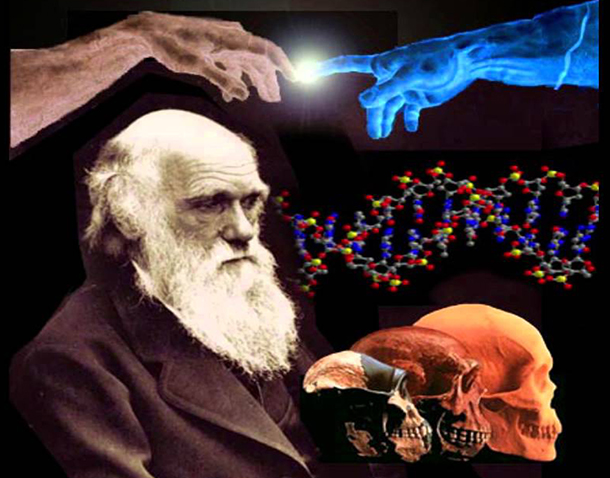
 

Tuesday, October 1, 2019

Darwinism has hardened into a dogma


Yale Uni. professor
 Doctor David Gelernter
renounces Darwinism
 

Part Two:
Darwinism has hardened into a dogma


“David Gelernter laments, from his own knowledge of American academia,
that there is “nothing approaching free speech” when it comes to Darwinism”.
 
David Klinghoffer


Abandoning Darwinism: Gelernter Talks with Meyer, Berlinski

 
July 22, 2019, 2:15 PM


How much would you pay to listen in on a conversation among computer scientist David Gelernter, philosopher of science Stephen Meyer, and mathematician David Berlinski, hosted by Peter Robinson from Stanford’s Hoover Institution? As it happens, and I didn’t see this coming, the four were together in Florence and they took the opportunity to have a fascinating exchange about the recent essay in which Gelernter, the Yale polymath, explained his reasons for rejecting Darwinian theory. See the whole thing here:
 
Gelernter’s intellectual confession, Giving Up Darwin,” was published in The Claremont Review of Books. As you can imagine, it caused a stir. Dr. Gelernter attributed his departure from evolutionary orthodoxy to having read books by Meyer (Darwin’s Doubt) and Berlinski (The Deniable Darwin), as well as one that I edited (Debating Darwini’s Doubt).
 
I had thought that Berlinski’s conversation with Robinson alone, noted here, was about the most interesting thing you could ask to watch. But this beats it. That is because of the remarkable diversity of views on display, from three thinkers who are all Darwin skeptics of one stripe or another.
 

A Beautiful Theory — But True?

 
They ask about whether Darwin’s theory is beautiful, about challenges to Darwin from mathematics and biology, whether there is any real difference between saying Darwin’s theory is “unlikely or impossible” in accounting for spectacular biological innovations, whether intelligent design is a sufficient substitute, and much else not strictly on topic.


For example, has Sigmund Freud, like Marx and Darwin, been “taken down” as a pillar of Western thinking? Berlinski and Gelernter emphatically think not.
 
David Gelernter laments, from his own knowledge of American academia, that there is “nothing approaching free speech” when it comes to Darwinism. This wonderful conversation gives you a sense of what a really free exchange of views would be like, the beauty and interest of it, were such a thing permitted on university campuses. Thank you very much to the indispensable Peter Robinson and his program, Uncommon Knowledge, for making it possible!
[End of article]
 
Chuck Colson likewise has written of:
 

The Dogma of Darwinism

IT’S A RELIGION

 
by: Chuck Colson
Category:
BreakPoint, Christian Worldview
September 14, 1999
 
Where did religion come from? According to Harvard biologist E.O. Wilson, religion is a product of evolution. In his new book Consilience, Wilson says belief in God must have given early humans an edge in the struggle for survival. But today, he says, traditional religions are being replaced by a new morality, a new unifying myth, based squarely on evolutionary biology.
 
Darwinism itself is becoming a new religion.
 
Wilson may sound radical, but he’s right. Darwinism is about much more than science: It provides the scientific support for an entire naturalistic worldview or religion. Broadly speaking, a religion is anything that functions as a person’s ultimate belief or worldview- anything that answers the basic questions of life: Where did we come from? What are we here for? How do we know what’s right and wrong?
 
For many people today, Darwinian evolution answers those fundamental questions. Where did we come from? From chance collisions of atoms, Darwinism says. Why are we here? There is no purpose to life, Darwinism says-no reason for existence. We are cosmic accidents. How do we know right and wrong? We DON’T know any objective moral law: Morality is merely an idea that appears in the human mind when it has evolved to a certain stage. Hence people make up their own ideas of right and wrong.
 
Cornell biologist William Provine sums up the implications Of Darwinism in simple bullet points: It means “No life after death; no ultimate foundation for ethics; no ultimate meaning for life; no free will.”
 
This is why the issue of Darwinism versus cosmic design Has become such a fierce battleground in America today. The debate is not just about fossils or genetic mutations. Our theory of origins determines our identity, our values, our sense of meaning.
 
This is why, in today’s world, the Christian message must begin with creation. We cannot simply start off with John 3:16 and the gospel message.
That’s like starting to read a book in the middle of the story–you don’t know the characters and you can’t make sense of the plot. We need to start with creation, where the main character of the “story” is introduced as the Creator of all, and the “plot” of human history begins to unfold.
 
Creation tells us who we are and why we are here. It tells us our lives DO have ultimate meaning. It gives the basis for morality, because if God created us for a purpose, then morality is the guidebook telling us how we fulfill that purpose. And when we live outside the bounds of the purpose for which we were created, that is sin. Suddenly theological terms make sense.
 
Creation is the basis for the entire Christian worldview.
 
A century ago, the great Dutch statesman Abraham Kuyper wrote that if we are going to stand against the powerful forces of unbelief today, we must understand that we face a clash of worldviews-and we must frame Christianity as an equally comprehensive worldview. That means beginning with the God who created “the heavens and the earth, and everything in it.”
 
For “everything in it” finds its meaning in Him.


Thursday, August 15, 2019

Assumption feast invites people to look to heaven with hope, pope says


  • In Catholic News Service, Vatican
  • Carol Glatz
    Aug 15, 2019
  • Mary’s assumption into heaven calls people to put aside all those insignificant, mundane and petty concerns competing for their attention and instead be drawn to God and his greatness, Pope Francis said.

    After reciting the Angelus prayer on the feast of the Assumption Aug. 15, Francis also blessed thousands of rosaries that will be given to Catholics in Syria “as a sign of my closeness, especially for families who have lost someone because of the war.”
    “Prayers made with faith are powerful. Let us keep praying for peace in the Middle East and the whole world,” said the pope, who explained that Aid to the Church in Need spearheaded the initiative to send some 6,000 rosaries to Catholic communities in Syria.
    He also expressed his concern and prayers for those affected by monsoons in South Asia.
    A week of heavy rains triggered deadly landslides and flooding in India, where, according to government officials, nearly 300 people died and more than 1.2 million people were forced from their homes. Officials in Myanmar reported more than 50 people have died there.
    “May the Lord give strength to those (affected) and those who help them,” the pope said.
    With the assumption of Mary, body and soul, into heaven, she is “like a mother who waits for her children to come back home.” Knowing that she is there with God in heaven “gives us comfort and hope during our pilgrimage” on earth, he said.
    The feast of the Assumption of Mary is an invitation to everyone, “especially for those who are afflicted by doubt and sadness, and live gazing downward,” he said.
    “Let us look on high,” he said, where Mary awaits. “She loves us, she smiles at us and she comes to our aid with haste.”
    Just as every mother wants what is best for her children, “she tells us, ‘You are precious in God’s eyes; you were not made for measly worldly gratifications, but for the great joys of heaven,’” the pope said.
    In life, it is important to seek what is truly great, “otherwise we get lost” chasing after so many trivial things, he said.
    “Mary shows us that if we want our life to be happy, God goes first because only he is great,” he said.
    “Instead, how often we live chasing after things that don’t matter: Prejudices, grudges, rivalries, jealousies, illusions, superfluous material goods. How much pettiness in life!”
    But today, “Mary invites us to lift our gaze up to the great things that the Lord has done for her” and reminds people that the Lord also does great things in them.
    “Let us be attracted by true beauty, let us not be swallowed up by the petty things of life, but let us choose the greatness of heaven,” he said.


    https://cruxnow.com/vatican/2019/08/15/assumption-feast-invites-people-to-look-to-heaven-with-hope-pope-says/

    Sunday, August 11, 2019

    Yale Uni. professor Doctor David Gelernter renounces Darwinism


    darwin-pigeon


    "My argument is with people who dismiss intelligent design without considering, it seems to me — it's widely dismissed in my world of academia as some sort of theological put up job — it's an absolutely serious scientific argument…. In fact it's the first and most obvious and intuitive one that comes to mind. It's got to be dealt with intellectually".
    Dr. David Gelernter


    Renowned Yale Professor
    Quits Darwin
     
    by Stephen Wynne  •  ChurchMilitant.com  •  August 8, 2019                                                      
     
    Dr. David Gelernter: Darwinism can't explain origin of species
     
    NEW HAVEN, Conn. (ChurchMilitant.com) - Famed Yale University computer science professor Dr. David Gelernter has renounced Darwinism.
    In a column for the spring edition of the 
    Claremont Review of Books, Gelernter announced that he is no longer a disciple of Darwin, saying the English naturalist's theory has been disproven.

    "Darwinian evolution is a brilliant and beautiful scientific theory," he wrote. "Once it was a daring guess. Today it is basic to the credo that defines the modern worldview."
    "Accepting the theory as settled truth ... certifies that you are devoutly orthodox in your scientific views; which in turn is an essential first step towards being taken seriously in any part of modern intellectual life," he added. "But what if Darwin was wrong?"In his seminal work The Origin of Species (1859), Darwin proposed that all life forms have descended from a common ancestor, suggesting that over time, random variation coupled with natural selection gives rise to entirely new species.
    But, Gelernter wrote, "The origin of species is exactly what Darwin cannot explain."
    "Darwin successfully explained the small adjustments by which an organism adapts to local circumstances: changes to fur density or wing style or beak shape," he noted. "Yet there are many reasons to doubt whether he can answer the hard questions and explain the big picture — not the fine-tuning of existing species but the emergence of new ones."
    Dr. Stephen Meyer A key problem for Darwinism, Gelernter said, is the Cambrian explosion. The fossil record reveals that "a striking variety of new organisms — including the first-ever animals — pop up suddenly in the fossil record over a mere 70-odd million years," which contradicts Darwin's assumption that "new life forms evolve gradually from old ones in a constantly branching, spreading tree of life."
    Chief among the flaws undermining Darwinism, he wrote, is molecular biology, which in recent decades has demonstrated that random mutation plus natural selection cannot give rise to new, more complex species.
    Gelernter credited three books for his shift in understanding: Dr. Stephen Meyer's Darwin's Doubt (2013), Dr. David Berlinski's The Deniable Darwin and Other Essays (2009) and David Klinghoffer's Debating Darwin's Doubt (2015).
    "These three form a fateful battle group that most people would rather ignore," he wrote.
    Gelernter singled out Meyer's work as especially praiseworthy: "Meyer ... disassembles the theory of evolution piece by piece. Darwin's Doubt is one of the most important books in a generation. Few open-minded people will finish it with their faith in Darwin intact."
     
    Darwinism is no longer just a scientific theory but the basis of a worldview, and an emergency replacement religion for the many troubled souls who need one. ….
     
    Meyer, director of the Center for Science and Culture at Seattle-based think tank the Discovery Institute, is an advocate of a replacement theory, intelligent design (ID).

    Biological life, ID proponents argue, is not the result of blind, undirected evolutionary processes, but the product of design by an intelligent entity.

    Many adherents are religious. But, as Gelernter observed, "Intelligent design as Meyer explains it never uses religious arguments, draws religious conclusions, or refers to religion in any way."

    Still, as ID has grown as a theoretical alternative to Darwinism, it has been savaged as a pseudo-scientific appeal to religion by committed Darwinists within the scientific establishment. This, Gelernter pointed out, is because Darwinism serves as their de facto faith:
     
    The religion is all on the other side. Meyer and other proponents of I.D. are the dispassionate intellectuals making orderly scientific arguments. Some I.D.-haters have shown themselves willing to use any argument — fair or not, true or not, ad hominem or not — to keep this dangerous idea locked in a box forever. They remind us of the extent to which Darwinism is no longer just a scientific theory but the basis of a worldview, and an emergency replacement religion for the many troubled souls who need one.
    Critics have long argued that Darwinism is atheistic philosophy disguised as science. Since Darwin's day, they note, it has been used to reject Christian orthodoxy and advance materialism, the view that human beings are merely the accidental results of unguided natural processes (as opposed to being purposefully created by God), and that the human mind is the only — and therefore, the supreme — consciousness that exists.
    I am attacking their religion and I don't blame them for being all head up, it is a big issue for them. ….
     
    In a 1997 article for The New York Review of Books, leading evolutionist and atheist Dr. Richard C. Lewontin testified to the fact that materialists are committed to Darwinism, in spite of its myriad inconsistencies and flaws, because they are committed to the denial of God.
     
    We take the side of science in spite of the patent absurdity of some of its constructs, in spite of its failure to fulfill many of its extravagant promises of health and life, in spite of the tolerance of the scientific community for unsubstantiated just-so stories, because we have a prior commitment, a commitment to materialism. It is not that the methods and institutions of science somehow compel us to accept a material explanation of the phenomenal world, but, on the contrary, that we are forced by our a priori [pre-existing] adherence to material causes to create an apparatus of investigation and a set of concepts that produce material explanations, no matter how counterintuitive, no matter how mystifying to the uninitiated. Moreover, that materialism is absolute, for we cannot allow a Divine Foot in the door.
     
    Gelernter worries that materialists' philosophical/religious commitment to Darwinism is precluding genuine scientific inquiry. In an interview with Stanford University's Hoover Institution last month, he expounded on this concern.

    "My argument is with people who dismiss intelligent design without considering, it seems to me — it's widely dismissed in my world of academia as some sort of theological put up job — it's an absolutely serious scientific argument," he said. "In fact it's the first and most obvious and intuitive one that comes to mind. It's got to be dealt with intellectually." ….


    Gemma Tognini: Law needs to recognise that a dead child is not ‘just a foetus’


    Illustration: Getty Images


    I’ve got a question, two actually, and I’m happy to be judged on their merits because I think the issue is important.
    Who gets to decide when an unborn baby matters? Furthermore, who gets to say what worth is placed on the life of an unborn child when that life is ended either intentionally or recklessly by a criminal act?
    Because they were not born, their lives aren’t acknowledged as more than a biological extension of their mother. The law in NSW does not look at what happened to Katherine and see three lives lost.
    No, the law in NSW — and in WA — sees the death of an unborn child as one of the mother’s injuries. The law says a baby must show independent life outside a mother’s body to be deemed a living person, and therefore a victim of crime.
    The law, as they say, is an ass.
    Who got to decide this, and when? Why is there such resistance to reforming this part of the Criminal Code?
    Those unborn twin boys were mourned in their own right. Relatives told media “these babies were already part of the family”. They were mourned to some degree by each one of us who read the story and wept a little on the inside.
    Like most of us, I know couples who’ve gone through the trauma of late-term miscarriage or stillbirth. Maybe you’re one of them.
    You can’t tell me the babies you lost were nothing more than a bunch of cells attached to a life source. They were your children.
    Disagree? OK, let’s have some real talk, some adult talk if you’re up for it.
    How many of you have ever been invited to a foetus shower? Didn’t think so. We hold baby showers to celebrate the pending arrival of a unique life, brimming with promise. An expecting couple doesn’t get asked, what sex is your foetus or, have you chosen a name for your foetus? I could go on, but best I don’t.
    Try telling parents who’ve lost a baby, or a woman who has delivered a stillborn child, that that baby is ‘just a foetus’ and doesn’t deserve to be recognised.
    We call them babies when they’re born and foetus when we try to justify everything else. The language we use sanitises truth for the sake of our comfort, softens the blow when the blow is worthy of being felt.
    A spokesman for Attorney-General John Quigley said the State Government had no plans to review WA’s legislation.
    I want to know why not.
    In NSW, the reform agenda is known as Zoe’s law. In 2009, Zoe Donegan was stillborn at 32 weeks after her mother’s car was hit by a mini-van. Behind the wheel, a drug-addled driver. You should google the story. It will break your heart. Zoe’s law seeks to amend NSW law to make it a crime to harm or destroy a child in utero. The Bill is yet to be passed and remains in limbo.
    A lot of the pushback on this kind of legislative change has come from pro-choice campaigners who fret that adjusting the law could affect legislation around late-term abortion.
    To me, the two issues are separate.
    To conflate them is at best mischievous, at worst a terrible insult to the women who chose to keep their babies, but were robbed of their choice and their children by a crime.
    What we’re talking about here is an appropriate penalty for criminal acts, and about recognising that life is precious, at every stage. If the law is drafted correctly, not reactively or in haste, there’s no need for concern.
    Murdoch University lecturer Lorraine Finlay is a former State prosecutor, a former associate to Justice Dyson Heydon in the High Court (among many other things) and has written extensively on the topic.
    She says while the concerns of pro-choice campaigners are important, the issues are not automatically interlinked. She wrote recently that the law can be drafted so that it has no broader implication for either abortion or the legal rights of pregnant women.
    As a society, we acknowledge that life, at every stage, matters.
    If it didn’t, we wouldn’t have such stringent, well-debated and carefully drafted abortion laws in Australia.
    The taking of life, either medically or via a reckless or intentional criminal act, is a monumental thing and as a society we recognise that.
    We don’t need to have further conversations around existing abortion laws. It’s about looking at current holes in the Criminal Code and plugging them. It’s about recognising that most of the difficult and complex social issues we face are worth the subsequent awkward and uncomfortable conversations.
    Try telling parents who’ve lost a baby, or a woman who has delivered a stillborn child, that that baby is “just a foetus” and doesn’t deserve to be recognised. You just wouldn’t.
    I mean, at the very least, stop and ask yourself, how would I feel if it were me, would current laws be enough?
    This conversation is about as fun as walking barefoot through a paddock full of doublegees.
    But here’s the thing — two ideas can and should be able to coexist in tension. This is no different — probably more emotive, but at the heart of it, no different.
    Zoe’s life counted. The lives of Katherine Hoang’s unborn twin sons, counted. The law needs to reflect that.

    Gemma Tognini is managing director of GT Media


    Friday, August 9, 2019

    Renowned Yale Professor Quits Darwin

    darwin-pigeon


    by Stephen Wynne  •  ChurchMilitant.com  •  August 8, 2019                                                      

    Dr. David Gelernter: Darwinism can't explain origin of species


    NEW HAVEN, Conn. (ChurchMilitant.com) - Famed Yale University computer science professor Dr. David Gelernter has renounced Darwinism.
    In a column for the spring edition of the Claremont Review of Books, Gelernter announced that he is no longer a disciple of Darwin, saying the English naturalist's theory has been disproven.
    "Darwinian evolution is a brilliant and beautiful scientific theory," he wrote. "Once it was a daring guess. Today it is basic to the credo that defines the modern worldview."
    "Accepting the theory as settled truth ... certifies that you are devoutly orthodox in your scientific views; which in turn is an essential first step towards being taken seriously in any part of modern intellectual life," he added. "But what if Darwin was wrong?"In his seminal work The Origin of Species (1859), Darwin proposed that all life forms have descended from a common ancestor, suggesting that over time, random variation coupled with natural selection gives rise to entirely new species.
    But, Gelernter wrote, "The origin of species is exactly what Darwin cannot explain."
    "Darwin successfully explained the small adjustments by which an organism adapts to local circumstances: changes to fur density or wing style or beak shape," he noted. "Yet there are many reasons to doubt whether he can answer the hard questions and explain the big picture — not the fine-tuning of existing species but the emergence of new ones."
    Image
    Dr. Stephen Meyer
    A key problem for Darwinism, Gelernter said, is the Cambrian explosion. The fossil record reveals that "a striking variety of new organisms — including the first-ever animals — pop up suddenly in the fossil record over a mere 70-odd million years," which contradicts Darwin's assumption that "new life forms evolve gradually from old ones in a constantly branching, spreading tree of life."
    Chief among the flaws undermining Darwinism, he wrote, is molecular biology, which in recent decades has demonstrated that random mutation plus natural selection cannot give rise to new, more complex species.
    Gelernter credited three books for his shift in understanding: Dr. Stephen Meyer's Darwin's Doubt (2013), Dr. David Berlinski's The Deniable Darwin and Other Essays (2009) and David Klinghoffer's Debating Darwin's Doubt (2015).
    "These three form a fateful battle group that most people would rather ignore," he wrote.
    Gelernter singled out Meyer's work as especially praiseworthy: "Meyer ... disassembles the theory of evolution piece by piece. Darwin's Doubt is one of the most important books in a generation. Few open-minded people will finish it with their faith in Darwin intact."
    Darwinism is no longer just a scientific theory but the basis of a worldview, and an emergency replacement religion for the many troubled souls who need one.Tweet
    Meyer, director of the Center for Science and Culture at Seattle-based think tank the Discovery Institute, is an advocate of a replacement theory, intelligent design (ID).
    Biological life, ID proponents argue, is not the result of blind, undirected evolutionary processes, but the product of design by an intelligent entity.
    Many adherents are religious. But, as Gelernter observed, "Intelligent design as Meyer explains it never uses religious arguments, draws religious conclusions, or refers to religion in any way."
    Still, as ID has grown as a theoretical alternative to Darwinism, it has been savaged as a pseudo-scientific appeal to religion by committed Darwinists within the scientific establishment. This, Gelernter pointed out, is because Darwinism serves as their de facto faith:
    The religion is all on the other side. Meyer and other proponents of I.D. are the dispassionate intellectuals making orderly scientific arguments. Some I.D.-haters have shown themselves willing to use any argument — fair or not, true or not, ad hominem or not — to keep this dangerous idea locked in a box forever. They remind us of the extent to which Darwinism is no longer just a scientific theory but the basis of a worldview, and an emergency replacement religion for the many troubled souls who need one.
    Critics have long argued that Darwinism is atheistic philosophy disguised as science. Since Darwin's day, they note, it has been used to reject Christian orthodoxy and advance materialism, the view that human beings are merely the accidental results of unguided natural processes (as opposed to being purposefully created by God), and that the human mind is the only — and therefore, the supreme — consciousness that exists.
    I am attacking their religion and I don't blame them for being all head up, it is a big issue for them.Tweet
    In a 1997 article for The New York Review of Books, leading evolutionist and atheist Dr. Richard C. Lewontin testified to the fact that materialists are committed to Darwinism, in spite of its myriad inconsistencies and flaws, because they are committed to the denial of God.
    We take the side of science in spite of the patent absurdity of some of its constructs, in spite of its failure to fulfill many of its extravagant promises of health and life, in spite of the tolerance of the scientific community for unsubstantiated just-so stories, because we have a prior commitment, a commitment to materialism. It is not that the methods and institutions of science somehow compel us to accept a material explanation of the phenomenal world, but, on the contrary, that we are forced by our a priori [pre-existing] adherence to material causes to create an apparatus of investigation and a set of concepts that produce material explanations, no matter how counterintuitive, no matter how mystifying to the uninitiated. Moreover, that materialism is absolute, for we cannot allow a Divine Foot in the door.
    Gelernter worries that materialists' philosophical/religious commitment to Darwinism is precluding genuine scientific inquiry. In an interview with Stanford University's Hoover Institution last month, he expounded on this concern.
    "My argument is with people who dismiss intelligent design without considering, it seems to me — it's widely dismissed in my world of academia as some sort of theological put up job — it's an absolutely serious scientific argument," he said. "In fact it's the first and most obvious and intuitive one that comes to mind. It's got to be dealt with intellectually."
    Image
    Dr. Richard C. Lewontin
    Gelernter said he's troubled by the conduct of many of his Yale colleagues, noting that "their intellectual behavior, what they have published — and much more importantly what they tell their students," doesn't reveal a commitment to scientific truth.
    "[W]hat I have seen in their behavior intellectually and at colleges across the West is nothing approaching free speech on this topic," he lamented. "It's a bitter, fundamental, angry, outraged rejection [of intelligent design], which comes nowhere near scientific or intellectual discussion. I've seen that happen again and again."
    "Darwinism has indeed passed beyond a scientific argument as far as they are concerned," he noted. "You take your life in your hands to challenge it intellectually. They will destroy you if you challenge it."
    Gelernter's observation echoes the testimony of multiple scientists who have been blacklisted for scientific "heresy," some of whom were profiled in Ben Stein's 2007 documentary Expelled: No Intelligence Allowed.
    Repeating his earlier assertion, Gelernter explained that those who question materialism's fundamental tenet are targeted because for materialists, Darwinism is faith: "I am attacking their religion and I don't blame them for being all head up, it is a big issue for them," he said.
    The students in my class, they're all Darwinsts. I am not hopeful.Tweet
    Critics of the theory point out that in the classroom, Darwinism is almost universally presented uncritically — that its weaknesses go unexamined. The result, they say, is that by college, untold numbers of students have been severed from religious belief, convinced by materialist teachers, professors and textbooks that theology is incompatible with science.
    In 2016, Georgetown University's Center for Applied Research in the Apostolate (CARA) published a study of why so many Catholic young people are leaving the Church. Summarizing the findings, Our Sunday Visitor contributor Mark M. Gray noted:
    The reasons young people leave are complex and varied. However, there is an emerging profile of one of the most common ways this happens. Many historians and Catholic theologians will say the Catholic Church has no place in a "war" between religion and science today. Yet the Church does appear to be losing a related battle nonetheless. Some young Catholics have told CARA that they are leaving the Faith for science, believing that Catholicism is incompatible with what they are learning in high school or at the university level.
    When asked "What are the reasons that explain why you are no longer Catholic?" the largest percentage of young ex-Catholics — 1 in 5 — said they abandoned the Faith because they no longer believed in God. Typical reasons given included:
    • "Because I grew up and realized it was a story like Santa or the Easter Bunny."
    • "As I learn more about the world around me and understand things that I once did not, I find that the thought of an all-powerful being to be less and less believable."
    • "I realized that religion is in complete contradiction with the rational and scientific world, and to continue to subscribe to a religion would be hypocritical."
    • "Need proof of something."
    • "It no longer fits into what I understand of the universe."
    Gelernter affirmed Darwinists' commitment to proselytizing.
    "Religion is imparted, more than anything else, by the parents to the children," he said. "And young people are brought up as little Darwinists. Kids I see running around New Haven are all Darwinists. … The students in my class, they're all Darwinists. I am not hopeful."


    https://www.churchmilitant.com/news/article/famed-yale-professor-quits-darwin