Wednesday, January 13, 2016

With His New Book, Pope Francis Unlocks the Door


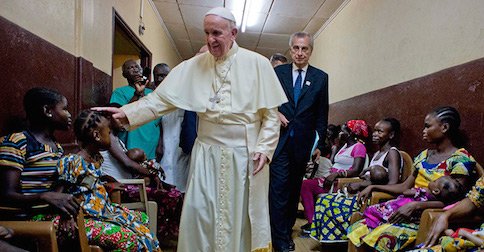
Pope Francis meets with people involved in the publishing of  "The Name of God Is Mercy" at the Domus Sanctae Marthae at the Vatican Jan. 11. The book features an interview the pope did with Italian journalist Andrea Tornielli. (CNS photo/L'Osservatore Romano, handout)
Pope Francis meets with people involved in the publishing of “The Name of God Is Mercy” at the Domus Sanctae Marthae at the Vatican Jan. 11. The book features an interview the pope did with Italian journalist Andrea Tornielli. (CNS photo/L’Osservatore Romano, handout)

By


A book on mercy might be expected to be a warm bath in kindliness, all sweetness and light, but Pope Francis, in “The Name of God Is Mercy,” offers a tough-minded reflection on an urgently needed public virtue, together with firm, if kindly, pushback against his critics.
The Pope’s now mythic line—“Who am I to judge?”—endeared him to many who long for humane authority, but it alarmed those who worry that the traditional center of religious and social order cannot hold. (Who are you to judge? You’re the Pope, that’s who!) That the question was asked in the context of an apparent tolerance of homosexuality made it especially threatening to the culture warriors, for whom gay rights is a flash point. Was the Pope yielding on a point of doctrine? Indeed, was doctrine at risk in his seeming openness to readmitting the divorced and remarried to Communion, or in his refusal to give due emphasis to other touchstone issues of sexual morality? Was there, in the Times columnist Ross Douthat’s incendiary phrase, a “plot to change Catholicism”?
Not that Francis equates himself with Jesus. What makes his book most moving is the way in which this man, without disrespecting his own privacy or offering false bromides of modesty (what Douthat derides as “ostentatious humility”), opens the sacred space of his conscience to explain how he came to center his ministry, and now his papacy, around mercy. “The Pope is a man who needs the mercy of God,” he tells Tornielli. “I said it sincerely to the prisoners of Palmasola, in Bolivia.” Palmasola is the infamous, vastly overcrowded, and hyper-violent penitentiary that Francis visited last July. “Every time I go through the gates into a prison to celebrate Mass or for a visit, I always think: why them and not me?” he says. “I should be here. I deserve to be here.”
In “The Name of God Is Mercy,” Pope Francis lets us see how he came to be the man he is. His most profound and shaping instruction, he says, occurred on the priest’s side of the confessional screen, where he was long entrusted with litanies of suffering, failure, despair, and sin. “When I heard confessions, I always thought about myself, about my own sins, and about my need for mercy, and so I tried to forgive a great deal,” he says. This was what he calls “the gift of confession,” and it was transforming. When he was a parish priest in Argentina, he tells Tornielli, a woman he knew “had to prostitute herself to provide her children with food.” He made sure that she and her children received gifts at Christmastime, but when the woman came to thank him, it was not for that. Rather, she explained that she was grateful “because you never stopped calling me ‘Señora.’ ”
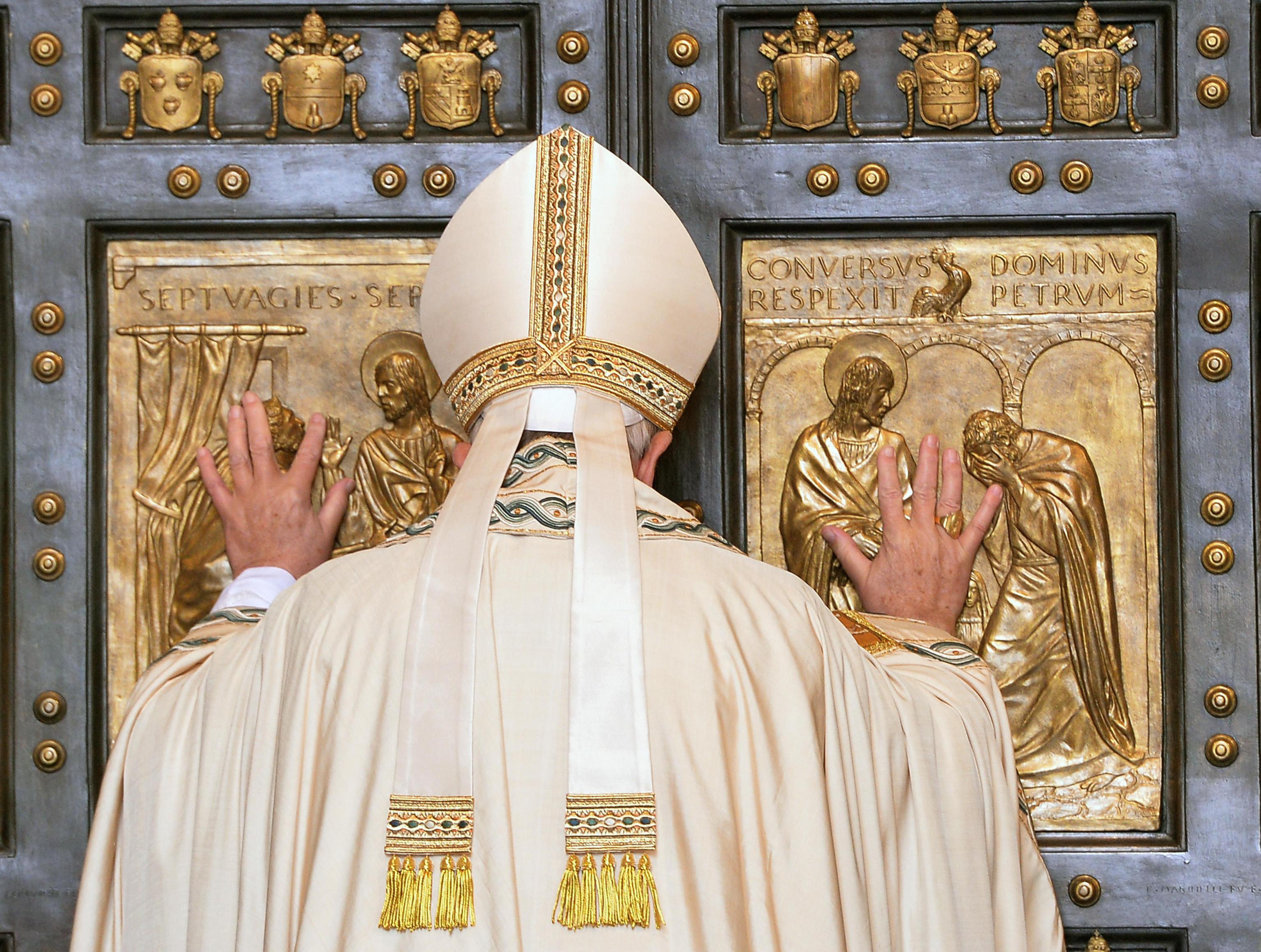
“As a confessor, even when I have found myself before a locked door, I have always tried to find a crack, just a tiny opening, so that I can pry open that door and grant forgiveness and mercy,” Francis says. His new book comes out toward the start of the Extraordinary Jubilee of Mercy, which he inaugurated in December, in a centuries-old ritual, by unlocking the ceremonial Holy Door of St. Peter’s Basilica. The Church of which Jorge Mario Bergoglio became Pope, nearly three years ago, was itself a locked door. As Francis, he has, exactly, found a “tiny opening.” He is pushing, and, to universal surprise, the door is beginning to swing open.

....

Monday, January 11, 2016

‘I made a huge mistake’ – Why one radical feminist changed her mind on abortion

Rio de Janeiro, Brazil, Jan 6, 2016 / 04:58 pm (CNA).- Brazilian feminist Sara Winter used to work to legalize abortion. She was one of the founders of a radical group that carries out offensive topless protests at churches.
Now, she says people should learn from religious women who put their faith into action – and reject the powerful forces promoting abortion in her country.
What changed her mind? The birth of her child.
“I understand I made a huge mistake, and I ask forgiveness from the bottom of my heart. The way to achieve public policy changes for women has nothing to do with mocking people’s religions,” she said in a Dec. 15 Facebook post.
“What I was missing was love (which changed when I became a mother), love that came to me after having reflected a lot on today’s militant feminism,” she said.
Sara Winter is the pseudonym of Sara Fernanda Giromin. Three years ago she was one of the founders of the Brazilian branch of Femen, a radical feminist organization of sometimes violent, often offensive activists who protest topless in favor of abortion and LGBT activism.
Winter asked for forgiveness “from all those people, whether religious or not, that I offended during a feminist protest last year involving a same-sex kiss in front of a church in Rio de Janeiro.”
Last month she denounced international funding to promote abortion in Brazil. She asked forgiveness for having been “part of that scheme to get abortion legalized.”
“But I never knew that all that talk about legalizing abortion in Brazil had been the work of organizations controlled by tycoons, rich men interested in reducing my country’s population.”
Sara confessed that she had always thought that an abortion was “something every woman should be able to get.”
“I’m not waving that flag any more. I don’t agree with women being jailed for having an abortion, I think they should always be treated with compassion, but I’m against the promotion of abortion being carried out by the feminist NGOs.”
The young woman also encouraged feminists “to learn from women who are religious.” While feminists are “putting on ridiculous protests (I myself used to be one of them) which are embarrassing to women, there are women of faith with homes protecting rape victims, and other women giving life by providing housing, taking in women in dangerous situations, and providing all kinds of assistance.”
“There are a lot of NGOs and institutions that need a helping hand and volunteers to care for the victims of violence, so let’s get going, help them, do your part. Take care of, assist and love other women,” she encouraged her readers.
Sara first began to speak about this radical turnabout in her life in October 2015.
“I regret having an abortion and today I’m asking for forgiveness,” she wrote on Facebook Oct. 14, almost one month after the birth of her second child. Since her baby was born, she said, “my life has taken on new meaning.”
“I don’t want you to go through the same thing I did,” she told her readers.
Years before, she underwent an abortion using a drug provided by a feminist.
“I almost bled to death and had very serious complications,” she recalled, adding that the person who came to her aid in those circumstances was a man who had “no connection to radical feminism.”
On abortion, she urged, “feminism should be focusing more on taking care of women instead of putting their lives at risk.” She said her prior abortion had caused difficulties early into her second pregnancy.
Sara has also become a critic of transgender ideology. She explained that she has no animus against people who say they are transgender, but she added, “I don’t think that changing your clothes, getting silicone breast implants and making the transition with hormones and surgery can change anybody’s sex.”
By mid-November, Sara was urging Brazilian feminists to “respect women who are religious believers.” Although she has no religious affiliation, she said that “one of the things I regret in my life is pulling away from God and devoting all my time to militant feminism.”
“Having faith is not a retrogression and other people’s religion needs to be respected,” she urged.
Sara said that she has faced a hostile reaction from the feminist faction she has abandoned.
“You have no idea of the reprisals I’ve been a victim of coming from the feminists,” she wrote. “I’m afraid of even stepping out on to the street with my baby, but I have faith that all this is going to go away.”
In early December, Sara published a short digital book about “seven times I was betrayed by the feminist movement.” The book is a compilation of the bizarre experiences she says she had as part of the Brazilian feminist movement, involved orgies, alcohol, drugs and misuse of funds.
For every book sold, she has offered to donate a Brazilian Real (about 25 cents) to “initiatives helping women in violent situations and against abortion.”
Sara stated that “feminism has a cure and I’m the greatest proof of that.”
She said the main reason Brazilian people do not like the feminists is because most of them act hysterically and use social media “to mock and humiliate religious people, preach hatred against men, besides being extremists and disrespectful of other people’s religious heritage.”
“I’m just as guilty. I used to be like that too, but thanks be to God I’ve been healed,” she said.
….


Taken from: http://www.catholicnewsagency.com/news/i-made-a-huge-mistake—why-one-radical-feminist-changed-her-mind-on-abortion-92648/

Sunday, January 10, 2016

Francis lays out case for mercy in 1st book as pope


VATICAN CITY (AP) — Pope Francis lays out his case for emphasizing the merciful face of the Catholic Church in his first book as pontiff, saying God never tires of forgiving and actually prefers the sinners who repent over self-righteous moralizers who don’t.
“The Name of God Is Mercy,” a 100-page conversation with Italian journalist Andrea Tornielli, is being published this week in 86 countries to help kick-start Francis’ Holy Year of Mercy. A copy was provided in advance to The Associated Press on Sunday.
In the book, Francis condemns what he calls the “scholars of law” — the doctrinaire-minded rigorists who throughout the history of the church have challenged Jesus’ message of unconditional love and mercy for even the most wretched of sinners. He says often these self-righteous Christians are hypocrites themselves, using the law to hide their own “deep wounds.”
“These are men who live attached to the letter of the law but who neglect love; men who only know how to close doors and draw boundaries,” Francis is quoted as saying.
Francis has rankled many conservatives with his frequent dismissals of theological and legalistic arguments stressing doctrine over his more pastoral message of welcome and mercy for society’s most marginal. The clash in approaches has been particularly evident in recent church debates over marriage and divorce.
“We must avoid the attitude of someone who judges and condemns from the lofty heights of his own certainty, looking for the splinter in his brother’s eye while remaining unaware of the beam in his own,” Francis says. “Let us always remember that God rejoices more when one sinner returns to the fold than when 99 righteous people have no need of repentance.”

Pope Francis holds the pastoral staff during a Mass …
Pope Francis holds the pastoral staff during a Mass in St. Peter’s Basilica, at the Vatican
The Vatican is officially launching the book Tuesday with a high-level panel discussion featuring Francis’ secretary of state, Cardinal Pietro Parolin, and ‘Life Is Beautiful’ actor Roberto Benigni, signaling the importance Francis places on getting the message out.
In the book, Francis insists that his now-infamous “Who am I to judge” comment about gays was merely a repetition of the church’s teaching on homosexuality. Francis won praise from gays with the comment, uttered during his first press conference in 2013. But many conservatives have criticized the remark as vague and incomplete since church teaching also holds that gay acts are “intrinsically disordered.”
Francis says the church has long held that gays should be treated with dignity and respect and seen as individuals. And he goes to some length throughout the text to cite scripture and previous popes to make clear that his radical agenda is fully rooted in the church’s basic teachings.
“People should not be defined only by their sexual tendancies: Let us not forget that God loves all his creatures and we are destined to receive his infinite love,” he says. “I prefer that homosexuals come to confession, that they stay close to the Lord, and that we pray all together. You can advise them to pray, show goodwill, show them the way, and accompany them along it.”
Francis has made clear from the start of his pontificate that his would be a papacy focused on mercy, and he called a jubilee year to emphasize it. Throughout the book, Francis refers repeatedly to his own ministry to prostitutes and prisoners in Argentina, showing how his own personal encounters with society’s outcasts have shaped his view about the faith and formed the bedrock of his papacy.

Pope Francis kisses during statue of baby Jesus a Mass …
Pope Francis kisses during statue of baby Jesus a Mass in St. Peter’s Basilica, at the Vatican
As a confessor, Francis is quoted as saying, “I have always tried to find a crack, just a tiny opening so that I can pry open that door and grant forgiveness and mercy.”
But Francis’ opening isn’t a free-for-all: He says of course prisons can’t throw their doors open and let violent criminals out onto the streets. But he says once a debt is paid, prisoners must be reintegrated back into society and welcomed. And he distinguishes between ordinary and even repeat sinners and those who are corrupt, saying corruption is a condition, a state of life and often a hypocritical one incompatible with Christianity.
“The corrupt man often doesn’t realize his own condition, much as a person with bad breath doesn’t know they have it,” he says.
Some conservatives have balked at Francis’ mercy-over-morals priorities, saying it has sent confusing messages to the faithful especially after two previous popes spent so much time stressing doctrine. Even some cardinals have called on Francis to make clear-cut policy statements on certain hot-button issues, especially on the divisive question of whether divorced and civilly remarried Catholics can receive Communion.
Church teaching holds that, if these Catholics are living in sin, they cannot receive the sacraments.
Francis launched a two-year study on the issue and other matters related to Catholic family life, and is expected to weigh in this year with a document on whether any accommodation can be found.
In the book, Francis doesn’t commit himself one way or the other, but he indicated that his ultimate decision may draw on a personal experience.
Francis recounts that one of his nieces wanted to marry a man who had children from a previous marriage but hadn’t yet obtained an annulment, a church decree that his first marriage was null.
The couple got married in a civil ceremony and went on to have three children. Francis recalls that every Sunday when they went to Mass the man went to confession and told the priest that he knew he couldn’t be absolved from the sin of adultery, but he asked for a blessing.
“This is a religiously mature man,” Francis said.
Progressives, led by the German bishops, have said such religiously mature Catholics should be allowed to participate fully in the life of the church, including receiving the sacraments.
___
Follow Nicole Winfield at www.twitter.com/nwinfield
  • Religion & Beliefs
  • Society & Culture
….

Taken from: http://news.yahoo.com/francis-lays-case-mercy-1st-book-pope-060520924.html

Wednesday, January 6, 2016

“Where is the child who has been born the King of the Jews?"


Pope Francis: Church doesn’t shine with its own light

2016-01-06 Vatican Radio
(Vatican Radio) In his homily at Mass celebrating the solemnity of the Epiphany, Pope Francis said the Church is called to be a missionary Church and announcing Christ is not a profession and nor is it about proselytism. He said the Church cannot delude herself that she shines with her own light but instead draws her brightness from the light of Christ.

Please find below a translation in English of Pope Francis’ prepared remarks for his homily at the Mass in St Peter's Basilica celebrating the solemnity of the Epiphany:

                The words of the Prophet Isaiah – addressed to the Holy City of Jerusalem – are also meant for us.  They call us to go forth, to leave behind all that keeps us self-enclosed, to go out from ourselves and to recognize the splendour of the light which illumines our lives: “Arise, shine; for your light has come, and the glory of the Lord has risen upon you” (60:1).  That “light” is the glory of the Lord.  The Church cannot delude herself into thinking that she shines with her own light.  Saint Ambrose expresses this nicely by presenting the moon as a metaphor for the Church: “The moon is in fact the Church… [she] shines not with her own light, but with the light of Christ.  She draws her brightness from the Sun of Justice, and so she can say: ‘It is no longer I who live, but Christ who lives in me’” (Hexaemeron, IV, 8, 32).  Christ is the true light shining in the darkness. To the extent that the Church remains anchored in him, to the extent that she lets herself be illumined by him, she is able to bring light into the lives of individuals and peoples.  For this reason the Fathers of the Church saw in her the mysterium lunae.
                We need this light from on high if we are to respond in a way worthy of the vocation we have received.  To proclaim the Gospel of Christ is not simply one option among many, nor is it a profession.  For the Church, to be missionary does not mean to proselytize: for the Church to be missionary means to give expression to her very nature, which is to receive God’s light and then to reflect it.  There is no other way.  Mission is her vocation.  How many people look to us for this missionary commitment, because they need Christ.  They need to know the face of the Father.
                The Magi mentioned in the Gospel of Matthew are a living witness to the fact that the seeds of truth are present everywhere, for they are the gift of the Creator, who calls all people to acknowledge him as good and faithful Father.  The Magi represent the men and woman throughout the world who are welcomed into the house of God.  Before Jesus, all divisions of race, language and culture disappear: in that Child, all humanity discovers its unity.  The Church has the task of seeing and showing ever more clearly the desire for God which is present in the heart of every man and woman.  Like the Magi, countless people, in our own day, have a “restless heart” which continues to seek without finding sure answers.  They too are looking for a star to show them the path to Bethlehem.
                How many stars there are in the sky!  And yet the Magi followed a new and different star, which for them shone all the more brightly.  They had long peered into the great book of the heavens, seeking an answer to their questions, and at long last the light appeared.  That star changed them.  It made them leave their daily concerns behind and set out immediately on a journey.  They listened to a voice deep within, which led them to follow that light.  The star guided them, until they found the King of the Jews in a humble dwelling in Bethlehem.
                All this has something to say to us today.  We do well to repeat the question asked by the Magi: “Where is the child who has been born the King of the Jews?  For we observed his star at its rising, and have come to pay him homage” (Mt 2:2).  We are impelled, especially in an age like our own, to seek the signs which God offers us, realizing that great effort is needed to interpret them and thus to understand his will.   We are challenged to go to Bethlehem, to find the Child and his Mother.  Let us follow the light which God offers us!  The light which streams from the face of Christ, full of mercy and fidelity.  And once we have found him, let us worship him with all our heart, and present him with our gifts: our freedom, our understanding and our love.  Let us recognize that true wisdom lies concealed in the face of this Child.  It is here, in the simplicity of Bethlehem, that the life of the Church is summed up.  For here is the wellspring of that light which draws to itself every individual and guides the journey of the peoples along the path of peace.
(from Vatican Radio)

Tuesday, January 5, 2016

Jesus: “I have revealed to you the whole ocean of my mercy”.

7 ways that St. Faustina is influencing Pope Francis on mercy

The Holy Year of Mercy has at its core a figure straight out of the St. John Paul II playbook


By John L. Allen Jr.
Associate editor January 4, 2016
ROME — Because Pope Benedict XVI was seen as a man of tradition, it was often easy to miss the innovative aspects of his papacy. In equal-and-opposite fashion, because Pope Francis is seen as a maverick, it’s tempting to overlook the various ways he stands in continuity with his predecessors.
Yet Francis’ signature initiative — probably the thing he would tell you he’s been building toward from the beginning, his Holy Year of Mercy — has at its core a figure straight out of the St. John Paul II playbook.
In fact, there’s a woman behind the pontiff’s jubilee: St. Faustina Kowalska, the Polish nun who launched the worldwide Divine Mercy devotion.

Faustina was an early 20th century mystic who belonged to an order called The Sisters of Our Lady of Mercy. She reported a series of visions, captured in her 700-page diary, in which she said Jesus told her to spread devotion to his mercy under the motto, “Jesus, I trust in you.”
Growing up in Krakow, the young Karol Wojtyla was fascinated that this message of mercy arose in Poland between the two World Wars. Later, as John Paul II, the Polish pope would beatify and canonize Faustina, and he also established a feast of Divine Mercy for the first Sunday after Easter — another request that Faustina said came straight from Jesus.
It’s true that Francis has not talked much about Faustina out loud in connection with his Year of Mercy, leading some devotees to wonder if she’s in danger of becoming the “forgotten woman” of the jubilee.

Yet upon closer examination, it seems clear that her fingerprints are all over it. Consider the following seven indications of her influence on Francis and his thinking about mercy.
1. Papal bull
When Francis issued a formal papal bull decreeing his holy year, titled Misericordiae Vultus, he chose to do so on April 11, 2015 — the vigil of the feast of Divine Mercy, the observance directly associated with Faustina.
“May she, who was called to enter the depths of divine mercy, intercede for us and obtain for us the grace of living and walking always according to the mercy of God and with an unwavering trust in his love,” he wrote.
2. Programmatic line
Looking back, it seems clear that the programmatic line for Francis’ jubilee came during his first airborne news conference returning from a trip to Brazil in July 2013.
Although he was asked specifically about Communion for the divorced and remarried, he gave a broad reply about the importance of mercy. He said he believes the present era is a “kairos” of mercy, using an evocative Greek New Testament term that means a privileged moment in God’s plan of salvation.
In the next breath, Francis cited John Paul II and Faustina.
“But John Paul II had the first intuition of this,” he said, “when he began with Faustina Kowalska, the Divine Mercy …. He had intuited that this was a need in our time.”


3. “Ocean of Mercy”
In his homily for this year’s New Year’s Day Mass, marking his first public utterance of 2016, Francis argued that alongside a “torrent of misery” in the contemporary world, there is also an oft-overlooked “ocean of mercy.”
Though he didn’t explicitly cite Faustina, he easily could have. “Ocean of mercy” is one of her signature phrases, appearing in her diary a robust 16 times.
Here’s a classic for-instance, in this case from one of her visions of Jesus: “I have revealed to you the whole ocean of my mercy,” she reports Jesus saying. “I seek and desire souls like yours, but they are few.”
In another place, Faustina writes that “during Holy Mass, I was given knowledge of the heart of Jesus and of the nature of the fire of love with which he burns for us … he is an ocean of mercy.”
4. Poland trip
At least in terms of crowd size and the magnitude of the event, the highlight of Pope Francis’ jubilee year isn’t likely to come in Rome. Instead it’s likely to be in Krakow in late July, when Francis travels there to lead the Church’s World Youth Day.
Obviously, the legacy of John Paul II and Faustina will be front-and-center throughout that trip.
To make sure no one misses the point, Francis signed off on making John Paul II and Faustina the co-patrons of World Youth Day, referring to them both as “apostles of divine mercy.” The outing shapes as an homage by Francis to Faustina and the pope who canonized her, and one can expect him to reflect on the Divine Mercy devotion at length.


5. The “misericordina”
On Nov. 17, 2013, Francis used his typical Sunday Angelus address to do something more customary in TV infomercials: He hawked a prescription drug, even having people hand out samples in St. Peter’s Square.
Only the “drug,” in this case, wasn’t actually from a pharmacy, even though it was made up to look that way. Instead it was a small packet containing a rosary, the Divine Mercy image with the motto “Jesus, I trust in you,” and instructions for use. Italians call it the misericordina, a play on the word for mercy.
“It’s a spiritual medicine,” the pope told the crowd that day. “Don’t forget to take it, because it’s good for you, it’s good for your heart, your soul, and your whole life.”


6. Roman priests
In March 2014, Francis held a session with priests of Rome in the Vatican’s Paul VI audience hall, saying he wanted to devote it to the theme of mercy. He spoke at length about John Paul II and Faustina.
“In his homily for the canonization, which took place in 2000, John Paul II emphasized that the message of Jesus Christ to Sister Faustina is located, in time, between the two World Wars and is intimately tied to the history of the 20th century,” Francis said, going on to quote several passages from the homily.
In a key line, Francis said, “Today we forget everything far too quickly … but we cannot forget the great content, the great intuitions and gifts that have been left to the People of God. And Divine Mercy is one of these.”
In retrospect, it seems a clear hint that Francis understands his jubilee of mercy as an extension of that “intuition and gift.”


7. Francis in Cuba
When Pope Francis traveled to Cuba just before heading to the United States last September, he chose “messenger of mercy” as the motto for the outing, making it something of a preview of his jubilee.
He said Mass in Havana’s Revolution Square on Sept. 20, and commentators noted the irony that alongside the towering images of Che Guevara and José Martí that dominate the space, there was also a large image of Jesus that was put up for the day.
What was less commented upon, however, was the nature of that depiction: It was the Divine Mercy image, with the motto “Jesus, I trust in you” in Spanish.


An earthier brand of mercy
Granted, the approach Francis takes to the theme of mercy is not simply a photocopy of Faustina’s.
Hers was a highly spiritual version of mercy, focused on compassion for lost souls and people suffering under the weight of sin. Francis’ brand of mercy is earthier, insisting on finding expression in concrete acts of solidarity with the poor, with migrants and refugees, with prisoners, and other victims of what he calls a “throwaway culture.”
That’s why one could make a strong case that the other woman behind the pope’s jubilee is Mother Teresa, and it’s probably no accident that her canonization also seems likely to take place during the year, perhaps in early September.
Yet these are questions of emphasis, not contradiction. Francis certainly would acknowledge that one does not have to be poor to need mercy, and it’s not as if Faustina was blind to the social gospel; the order she joined in Poland, after all, was devoted to helping troubled women, including unwed mothers and prostitutes.
Make no mistake: Francis is a change agent in many respects. But when it comes to his jubilee of mercy, he’s not reinventing the wheel; he’s giving a new push to a wheel that started rolling with a Polish nun and was sped up by a Polish pope.
As a final note, Francis would no doubt also say that Faustina offers a classic illustration of his oft-stated argument that women in Catholicism don’t have to be ordained priests in order to exercise influence.
It’s entirely possible that by the end of the jubilee, it’ll be like a hockey game with three stars of the game acknowledged: Francis, who called it; Faustina, who inspired it, and Mother Teresa, who provided its model for mercy-in-action.
In other words, the female contribution may actually trump that of the male. If so, that’s something in which a pope who’s repeatedly vowed to seek greater roles for women in the Church may find food for thought.

John L. Allen Jr., associate editor, specializes in coverage of the Vatican. More


Saturday, December 19, 2015

Pope Francis was in his element when he opened the ‘Door of Charity’ for the poor

Pope Francis opens the Holy Door of St. Peter's Basilica to inaugurate the Jubilee Year of Mercy at the Vatican Dec. 8. (CNS photo/Maurizio Brambatti, EPA)


Pope Francis opens the Holy Door of St. Peter’s Basilica to inaugurate the Jubilee Year of Mercy at the Vatican Dec. 8. (CNS photo/Maurizio Brambatti, EPA)


ROME — Years from now, records will show that the special jubilee Year of Mercy decreed by Pope Francis began on Dec. 8, 2015, the feast of the Immaculate Conception. If you ask the pontiff himself, however, he’d probably tell you it really got underway on Friday.
That afternoon, Francis headed across town to visit a hostel for the homeless run by Caritas, the main diocesan charity in Rome, in order to open a “holy door of charity.” In a sense, it was the natural follow-up to what happened on Dec. 8, when Francis threw open an ornate door to St. Peter’s Basilica that’s otherwise bricked up when jubilees aren’t underway.
That gesture traditionally is how jubilee years commence, but Friday’s rite was a novelty — a pontiff opening a door not to a church, where spiritual indulgences are on offer, but rather a charity center, where the “grace” dispensed is more tangible and this-worldly.
In most of the ways that matter, this was Pope Francis in his element.
Anyone who spends time watching Francis in action realizes he doesn’t particularly care for big ceremonial productions. He’s most comfortable in smaller, more intimate settings, especially with people who don’t qualify as VIPs, where he can set aside whatever speech has been prepared for him and go off-the-cuff in Spanish or Italian.
Celebrating Mass on Friday for a group of 200 people representing the various activities run by Caritas in Rome — homeless people, AIDS patients, mothers with developmentally challenged children, refugees, and so on — was, to hear Francis tell it, an expression of the heart of what the Year of Mercy is supposed to be all about.
“When we get close to those who are suffering, those who’ve been thrown away in society, that’s where Jesus is,” the pontiff said in his extemporaneous homily.
“If you want to find God, you have to seek him in humility, in poverty, where he’s hidden — in the needy, the neediest, the sick, the hungry, the prisoners,” he said.
The hostel Francis visited Friday afternoon is named for Don Luigi di Liegro, the founder of Caritas in Rome who ran it until his death in 1997. He was famed for bringing together disparate groups — the Salvation Army, Mother Teresa’s Sisters of Charity, Sant’Egidio, among others — into an effective network to serve the city’s poor, its immigrant population, and people often ignored by public institutions, such as residents with mental and psychological difficulties.


The fact that Francis was at home there, however, didn’t mean all was sweetness and light. On the contrary, the pontiff sounded almost like an Old Testament prophet in warning affluent and comfortable Romans about the consequences of indifference.
“Jesus has told us how our judgment will be,” Francis said. “He won’t say: ‘You, come with me because you gave lots of beautiful offerings to the Church, you were a benefactor of the Church, so come into Heaven.’ No, you can’t buy your way into Heaven,” Francis said.
“Jesus won’t say: ‘You were very important, you studied a lot and earned many honors, come into Heaven.’ No. Honors don’t open the door of Heaven.


“What will Jesus say? ‘I was hungry and you gave me something to eat; I was homeless and you gave me a place to live; I was sick and you visited me; I was in prison and you came to see me’.”
Francis offered up a prayer that the Lord will help everyone grasp that “the paths of presumption, of wealth, of vanity, of pride, are not the ways to salvation.”
Looking out at a group of people typically seen as “discarded” by society, Francis said that feeling of being tossed aside is actually a “grace.”
“It would be beautiful if every one of us, all Romans, felt discarded, and thus felt the need of God’s help,” the pontiff said.
Francis celebrated the Mass along with four other priests, including the Rev. Tommas Fanti, who, at 96, is still going strong in serving Rome’s poor. The readings and prayers of the faithful were presented by the people whom Caritas serves; the prayers were actually written by a young mother with a disabled child, a refugee requesting asylum in Italy, and a homeless person living in the hostel Francis was visiting.
Basically, the pope’s message was that these folks are not only what the Year of Mercy is all about, but also the Christmas season.
“In choosing how he’d lead his [human] life, the Lord didn’t pick a great city with a grand empire, he didn’t pick a princess or a countess for his mother, somebody important, and he didn’t choose a luxurious palace,” Francis said.
“It seems that it was all done intentionally,” he said, referring to the Christmas story of Jesus’ birth, in order that the Lord would be “hidden” by the usual worldly standards.
Upon leaving the hostel, Francis urged people to go forward during the jubilee year in an “embrace of mercy.”
Over the coming days, Francis will conduct any number of important engagements: his annual speech to the Roman Curia, the Christmas liturgies, his New Year’s Day Urbi et Orbi blessing, a meeting with the diplomatic corps, and so on.
In terms of getting to the core of what he wants his jubilee year to be about, however, it’s hard to imagine that for him anything will top Friday’s encounter with the “hidden” and “discarded” who clearly form this pope’s comfort zone.

....

Taken from: http://www.cruxnow.com/church/2015/12/19/pope-francis-was-in-his-element-when-he-opened-the-door-of-charity-for-the-poor/

Sunday, December 13, 2015

Pope Francis was right about condoms and HIV

Embedded image permalink

By Mary Rezac
 
Vatican City, Dec 13, 2015 / 04:02 am (CNA/EWTN News).- On his return flight from Africa, as Pope Francis fielded the customary questions from the press, he challenged a journalist on a question about condom use in the fight to prevent HIV.
“We know that prevention is key. We know that condoms are not the only method of solving the epidemic, but it’s an important part of the answer,” the journalist said. “Is it not time for the Church to change its position on the matter? To allow the use of condoms to prevent more infections?”
The question, Pope Francis said, seemed too narrow to address such a widespread and complex issue. Condom use in and of itself could never solve the HIV crisis or other problems facing many African nations.
“The problem is bigger,” the Pope said.
“This question makes me think of one they once asked Jesus: ‘Tell me, teacher, is it lawful to heal on the Sabbath? Is it obligatory to heal?’ This question, ‘Is doing this lawful,’…but malnutrition, the development of the person, slave labor, the lack of drinking water, these are the problems.”
The Catholic Church has always held that artificial contraception use is immoral. In a 2010 book interview that made waves, Pope Benedict XVI said that while using a condom can represent a step in the right direction as far as showing concern for the other person, it is still an immoral solution to the HIV crisis.
But was Pope Francis right to be so dismissive of condom usage? Do condoms actually play a practical and important role in the fight against HIV?
An increasing amount of evidence says no.
 
Abstinence and fidelity in Uganda
 
At the peak of the HIV crisis in the 1980s, the country of Uganda had one of the highest infection rates – almost 25 percent of the population were HIV positive by 1991, according to the Washington Post.With the help of the country’s religious leaders, Uganda President Yoweri Museveni adopted the simplest and least expensive intervention possible in the poor and war-torn country – a public education program stressing abstinence before marriage and faithfulness afterward, largely de-emphasizing condom use except for those most at risk.
In just eight years, the country saw the most significant decline in HIV infection rates in the world.
According to a 2004 article in the “Journal of International Development”, it was “the lack of condom promotion during the 1980s and early 1990s (that) contributed to the relative success of behavior change strategies in Uganda.”
But just as Uganda was seeing a significant decline, the United States intervened, restructuring the country’s approach and focusing more on condoms and less on abstinence and monogamy. In an op-ed for the Washington Post, Harvard’s leading HIV researcher Dr. Edward Green and Wilfred Mlay, then-vice president for World Vision Africa, wrote that while the United States was generous in offering their help, the Western ideologies and approaches may have actually undermined the success previously seen in Uganda.
“The Ugandan turnaround was well underway by the time foreign AIDS experts began to arrive in the early 1990s, bringing with them the Western public health approaches—and values. They began to retool Uganda’s AIDS prevention efforts away from abstinence and fidelity—goals that many Westerners felt were unrealistic. As condom use increased, the percentage of young singles having sex rose from 27 percent to 37 percent between 1995 and 2000. Health officials worry that infection rates may increase as well,” they wrote.
The problem with condoms
Regardless of religious belief, condom use to curb HIV infection proves problematic for several reasons.
One of the biggest issues with the promotion of condoms as a solution to HIV is that most people do not consistently or correctly use condoms, even after going through sex education.
A study published by “The Annals of Pharmacotherapy” found that out of 500 couples who were repeatedly told by their doctors to use condoms, only eight percent did so consistently, despite knowledge that one partner had herpes. A different study found that only 50 percent of couples in which one partner had HIV used condoms consistently over time.
Another part of the problem is something called risk compensation. In an interview with the BBC, Dr. Green said that risk compensation happens when people use risk-reducing technology in a way that assumes the technology cancels out all risk.
As an example, in an interview with BBC, Dr. Green compared condom use to sunblock. He said the protection offered by sunblock is cancelled out when the person using sunblock assumes they are completely protected and therefore spends even more time in the sun.
Similarly, people using condoms are more likely to engage in risky sexual behavior because of the assumed protection, when in fact repeated exposure to infected persons decreases the protection that condoms offer.
The phenomenon of risk compensation also means people using condoms are more likely to have a greater number of sexual partners, increasing their risk for certain STDs which in turn increases the likelihood of the transmission of HIV. Many STDs create open sores, which act as portals of entry for HIV infection.
Another reason condoms alone fail at protecting people against HIV is because of the likelihood of disease transmission over time. According to a 2001 article in The Lancet, the more frequently one changes sexual partners, the more likely it is that they will spread HIV.
This is because HIV is highly contagious when it is first contracted, but it is often not detectable until later. Therefore, an infected person could think they are HIV-free and go on to infect more people before they realize they have HIV. The study found that if there were at least six months in between sexual partners, the rate of HIV infections would significantly decrease.
 
A tale of two countries: Philippines vs. Thailand
 
Two different countries in Asia help further illustrate the effectiveness of abstinence and fidelity programs over condom promotion.In 1984, both countries reported their first case of HIV infection. But the two governments had radically different responses.
Thailand’s response was to promote condom use across the board, while the largely Catholic country of the Philippines focused their response on promoting abstinence before marriage and fidelity afterwards.
By 2005, the HIV rate in Thailand was 50 times higher than that of the Philippines.
And while some experts hail Thailand as a success story rather than the Philippines, since Thailand’s rate of infection eventually decreased from previous levels, other experts say it is no coincidence that the Catholicism which permeates Filipino culture has led to a small rate of HIV infection.
 
Catholicism and HIV infection rates
 
Although some experts are hesitant to recognize the effectiveness of abstinence and fidelity programs promoted by the Catholic Church, a 2005 article in British Medical Journal hailed their success.
“The greater the percentage of Catholics in any country, the lower the level of HIV. If the Catholic Church is promoting a message about HIV in those countries, it seems to be working,” the article states.
“On the basis of data from the World Health Organization, in Swaziland, where 42.6 percent have HIV, only 5 percent of the population is Catholic. In Botswana, where 37 percent of the adult population is HIV infected, only 4 percent of the population is Catholic. In South Africa, 22 percent of the population is HIV infected, and only 6 percent is Catholic. In Uganda, with 43 percent of the population Catholic, the proportion of HIV infected adults is 4 percent.”
Dr. Green, too, emphasized in a 2009 article that his support of abstinence and fidelity programs comes not from a conservative worldview but rather from his experiences in Africa and from looking at the results.
“I’m a flaming liberal, don’t go to church, never voted for a Republican in my life,” he said.
In his aforementioned op-ed, he also added that it would be a wrong to place politics and ideologies above the lives of people who are at risk.
“Billions of dollars and the lives of countless men, women, and children will be wasted if ideology trumps proven health policy.”
….
Taken from: http://www.catholicnewsagency.com/news/the-pope-was-right-about-condoms-and-hiv-49253/

Tags: Contraception, HIV/AIDS, Pope Francis
 

Read next »

How Pope Francis is fulfilling a legacy of Vatican II